

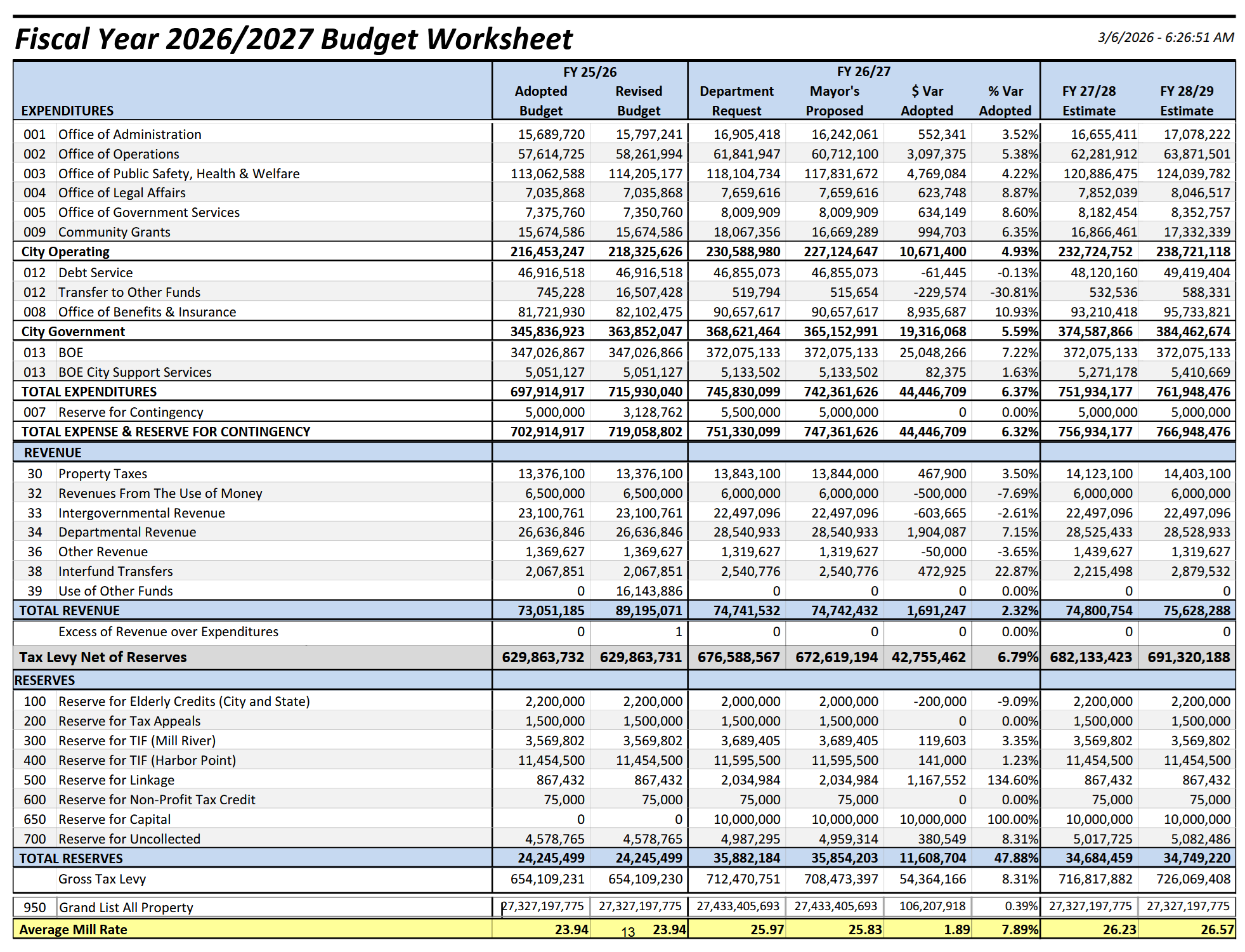
STAMFORD — Every spring, the City of Stamford releases a budget — a document that defines how the hundreds of millions of tax dollars will be spent for the next fiscal year. The “fiscal year” runs from July 1 to June 30 across calendar years, so the budget is typically proposed in March and passed by May.
At the time of this explainer’s publication, Mayor Caroline Simmons presented a proposed fiscal year 2026-2027 budget to the Board of Finance and Board of Representatives. She opened with an acknowledgment that the 6.32 percent increase was “significantly higher” than in previous years. This was uniquely strange since Simmons was in office for two global events that would impact the local budget — the high inflation period of President Biden and the high tariff period of President Trump.
Which invites the question: If the budget didn’t have a significant increase during these global events, why is it experiencing an increase now?
Multiple Stamford municipal budget experts agree: Stamford’s budget is a lagging indicator of fiscal management of the city. In other words, a budget increase (or potentially a budget decrease) in this calendar year is the result of actions taken in the past several years.
How the budget is structured
The city budget is made up of individual budgets for each department that report into a specific office.1 These include:
Office of Administration.
Office of Legal Affairs.
Mayor’s Office, which includes Economic Development, that is treated as its own office but has no departments underneath it.
Each office has a “Director” who is part of the “Mayor’s cabinet.” All departments in the city report to one of these offices. For example, the Sanitation Department reports to the Director of Operations; the Stamford Police Department reports to the Director of Public Safety, Health & Welfare; and the Tax Collector reports to the Director of Administration. Stamford operates under a “strong mayor” system, so all offices report to the mayor, and the mayor has the ability to increase or decrease the budget of any specific department.
The mayor is obligated to submit a budget proposal each year, but the budget must be approved through a process that relies on a number of democratic checks on the mayor’s power.
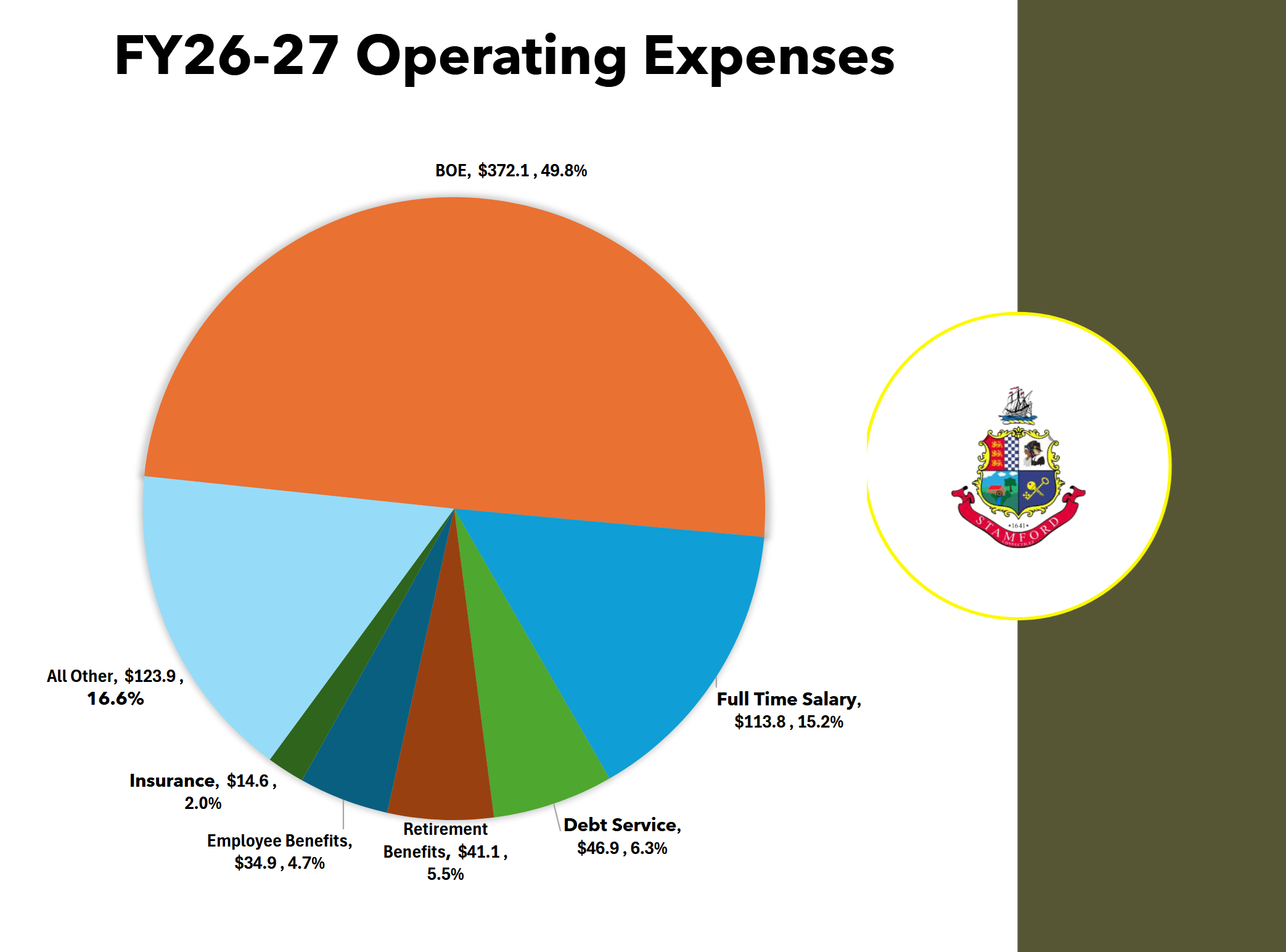
The majority of the budget is covered by the “operating budget.” The operating budget covers the day-to-day expenses of city services such as salaries for employees, healthcare for workers, and debt payments — such as pension payments or other “post-employment benefit obligations” (or “OPEB”).
In addition to the “operating budget,” there is the “capital budget.” The capital budget is made up of capital projects — which are essentially infrastructure projects. These are long-term investments that take years or decades to pay off through city taxes or bonds.2
There is also the “board of education budget” (BOE). The BOE budget is a significant contributor the overall budget — close to or exceeding 50 percent — but it is not the focus on this article.
The budget process begins with the mayor working with city staff to create budgets for each individual department. This “city staff” is primarily the Office of Policy and Management (OPM), which “owns” the creation of the city budget and provides guidance for departments to create their budget. This process typically begins in September.
Since all departments and offices report to the mayor, the mayor has the authority to cut or add to any budget. Depending on priorities, the mayor may make modifications to the budget before it is publicly announced and submitted for review from democratically elected oversight boards.
These oversight boards are the Board of Finance and the Board of Representatives. Both boards have the ability to cut “line items” from the budget, but they cannot add to the budget. This creates an incentive for the Mayor of Stamford to propose a higher budget with the expectation the budget will be cut by the oversight boards. With this in mind, mayoral proposals are reliably higher than the approved budget.
Historically, there is an expectation the mayor’s budget is proposed and approved in coordination with oversight boards. For example, each board may express priorities to the mayor ahead of the budget presentation. Cuts proposed by the boards are typically done after conversations with city staff or the mayor’s office. However, in recent years the local boards have pursued cuts without coordinating with city staff or the mayor’s office.
The budget is a delayed indicator of city management
One of the most important things to understand about any city budget is that it is largely a reflection of decisions made years earlier. In that sense, it is less a management report card than a lagging indicator — a record of past commitments coming due.
The most significant of those commitments are union contracts. The vast majority of city employees are unionized, and their wages, benefits, and work rules are governed by contracts that are typically negotiated every 3 years. When a contract is settled, its cost increases are baked into future budgets automatically. These cost increases remain even if other financial factors change or if the mayoral administration changes due to an election.
The same is true of bonding for capital projects.3 When the city “bonds” for capital projects, it is essentially borrowing money to build infrastructure such as a school or a bridge. These projects appear in the capital budget for years afterward – and sometimes in debt service obligations if payments were structured over many years or decades. In other words, the projects that get approved this year become the debt payments of a future administration.
A significant influence on the city budget is healthcare costs for union workers. Stamford switched to the state’s partnership health plan in part to reduce costs. However, this reduced the City of Stamford’s direct control over things like premium costs. In 2026, the proposed budget reflects compounding costs of higher insurance premiums, rising prescription drug costs, and high utilization rates — none of which were the result of decisions made this year, or decisions made by Stamford’s mayor.
This does not mean mayors have no influence.
Contracts can be negotiated aggressively or generously.
Capital projects can be prioritized or delayed.
Reserves can be built up or drawn down.
These choices take years to show up in the bottom line. Any budget a mayor presents is a product of choices inherited or made earlier in an administration.
In 2026, Mayor Simmons has been in office for 5 years. She has significantly more influence over the budget now compared to the budget she inherited in her first year.
Why “cutting the budget” is harder than it sounds
A common assumption in the public is a government budget is like a personal budget – or a corporate budget. These latter types of budgets contain “discretionary spending” that can be trimmed when times are tight. For a city like Stamford, that assumption understates the constraints of the budget.
Salaries for unionized employees are set by contract and cannot be reduced without renegotiation.4 The city’s pension and OPEB obligations are legally required contributions. Debt service on outstanding bonds is a fixed obligation. Healthcare premiums are set by the state plan. All of these costs are “nondiscretionary” and cannot be easily reduced or changed without significant legal intervention. These categories of expenses make up more than $250M — or 67 percent of the city’s operating budget, according to the budget submitted in 2026. Local municipal budget experts claim nondiscretionary costs could be up to 95 percent of the city budget.
What remains after those commitments is the BOE budget and a relatively small number of other costs.5 Outside agency and nonprofit funding — which includes the Ferguson Library, the Stamford Museum and Nature Center, and others — is among the few line items that can be adjusted without touching a contract or a legal obligation. Cutting these items can create significant negative impact on Stamford’s community without significant positive impact on the city’s budget — such as cutting funding to the library, homeless shelter nonprofits, or community centers.
Special positions in the mayor’s office, discretionary capital improvements, and certain program funding represent additional areas of flexibility. But together, these categories make up a small fraction of a $747 million budget.
“The mill rate went down” — and other misleading metrics
One of the most misunderstood metrics for affordability in Stamford — and Connecticut in general — is the “mill rate.” The mill rate is the amount of tax owed per $1,000 of assessed property value. The problem is most people don’t understand what that metric means so they frequently say misleading things.
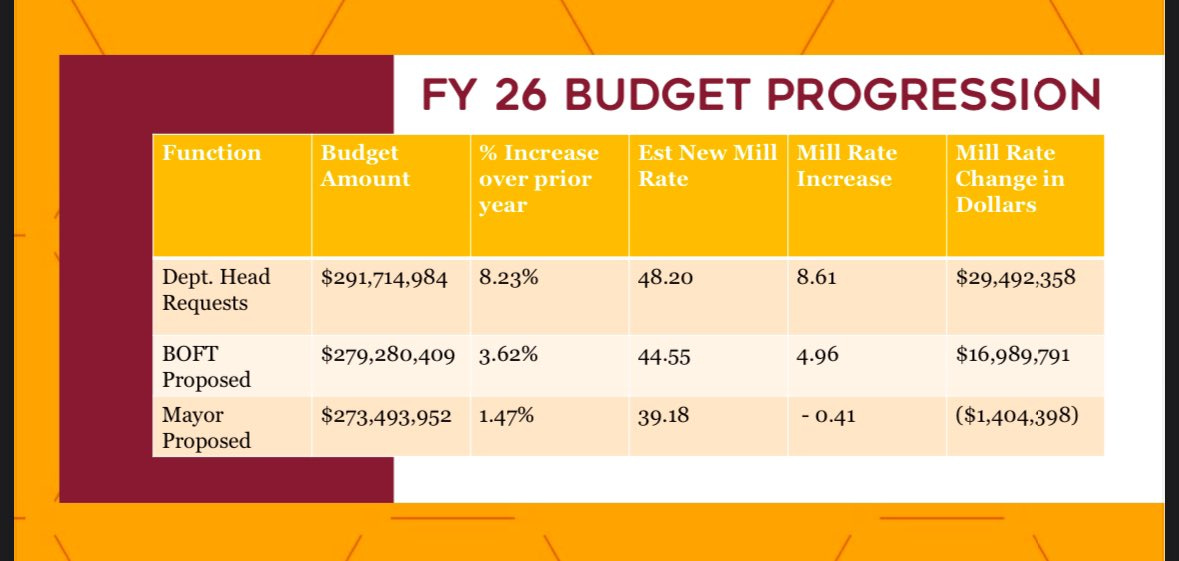
For example, Republican candidate for Governor Erin Stewart announced in 2025 — for her final year as Mayor of New Britain — she proposed a budget that would “[lower] taxes.” She said this because the mill rate went down. If you review that budget, you will discover:
· The amount of operating expenses in New Britain year-to-year went up.
· The amount of tax dollars collected by the City of New Britain year-to-year went up.
· The mill rate in New Britain year-to-year went down.
How is that possible?
Because the mill rate is the amount of tax owed per $1,000 of assessed property value.
In other words, if your property values go up then your mill rate will go down. If you’re overseeing a housing crisis – where property values are inflated – your mill rate will go down.
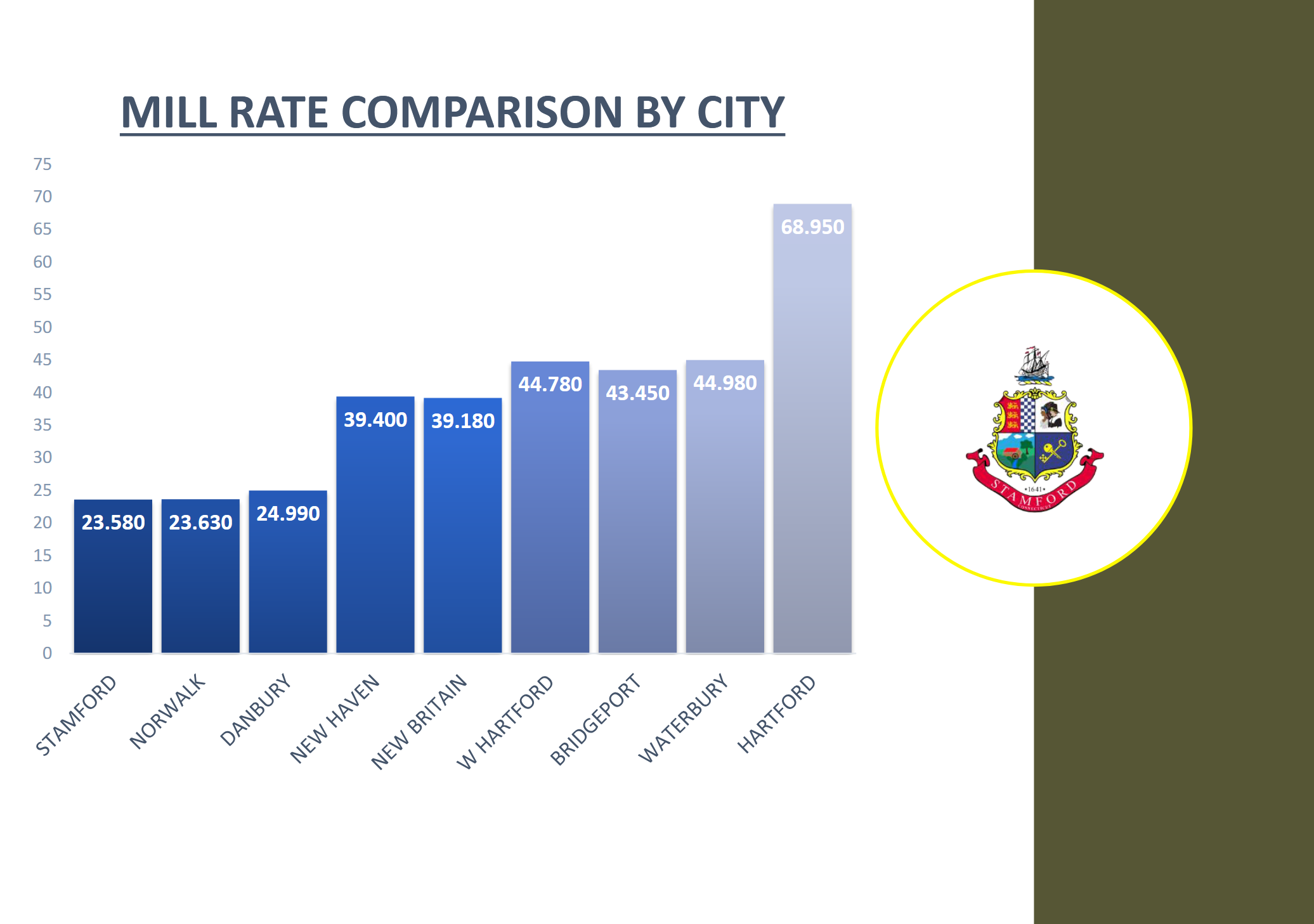
Mayor Simmons had a similar presentation in her budget presentation. She showed Stamford has one of the lowest mill rates in Connecticut. This comparison doesn’t mean anything. It is essentially showing everyone else pays 10 percent of $100,000 but in Stamford we only pay 1 percent of $1M!6 Stamford’s property values are higher, so our mill rate is lower.
The practical concern for ordinary residents is not the mill rate, but if city expenses have gone up and how the mill rate will be collected. For example, a previous re-evaluation of property in Stamford could have reduced taxes for multifamily homeowners but this impact was delayed to benefit single-family property owners. When evaluating budget claims, the relevant number is the projected change in total taxes paid — not the direction of the mill rate.
You could focus on the total of city expenditures rather than the mill rate, but that is also an incomplete picture. Municipal budgets often receive revenue through fees or state grants. It is possible for expenditures to be offset by revenues so there is not a notable tax increase. It’s also possible for expenditures to become more apparent because typical revenues are not collected. For example, Mayor Simmons shared this was the first year the city did not receive any federal grants for capital projects.
The most complete picture of fiscal impact combines both sides. What the city is spending? And where is the money to pay for it coming from?
What questions to ask during budget season
With those mechanics in mind, a few questions tend to reveal more about a budget than the headline number:
How much of the increase is driven by fixed costs — contracts, healthcare, debt service — versus new spending decisions?
A budget that rises 6 percent because of contractual obligations locked in three years ago tells a different story than one that rises 6 percent because the administration chose to add staff or expand programs. Mayor Simmons has recommended new positions, but the increase in costs is mostly driven by fixed costs rather than new discretionary spending.
What is the trajectory of long-term liabilities?
Pension funding levels, OPEB reserves, and outstanding bond debt are indicators of how much future flexibility the city is preserving or consuming today.
What is happening on the revenue side?
A budget that holds expenses flat but loses state grants still raises the tax burden on local property owners. The operating budget’s expense total is only half the picture. Mayor Simmons shared the city is not receiving any federal grants for capital projects, which is a significant impact to revenue.
Finally: what decisions being made this year will show up as fixed costs in the budgets three years from now?
Considering Mayor Simmons has been in office for 5 years, the question might be: what happened 3-4 years ago to result in the highest proposed budget increase since the Great Recession?
Residents who want to follow the budget process can review the Board of Representatives Fiscal Committee’s scheduled meeting dates for the FY2026-27.
[3] The FY2627 capital budget authorizes $73.1 million in project spending, with $36.5 million funded through general obligation bonds.
[4] Union employees have a number of protections from “layoffs” too.
[5] The BOE budget is $372.1M which represents 49.8 percent of the budget.
[6] It’s the same number: $10,000.
The official names of these entities are sometimes different from the commonly used term. For example, most people say the “Department of Operations” even though it is technically the “Office of Operations.” Similarly, the “Department of Transportation” is officially called the “Transportation, Traffic, & Parking Bureau”. Most humorously, the “Office of Legal Affairs” has a page called “Law Department” which describes the duties of “Corporation Counsel.” Officially, a “department” reports to an “office” that reports to the mayor.
The FY2627 capital budget authorizes $73.1 million in project spending, with $36.5 million funded through general obligation bonds.
Union employees have a number of protections from “layoffs” too.
The BOE budget is $372.1M which represents 49.8 percent of the budget.
It’s the same number: $10,000.