


STAMFORD — Mayor Caroline Simmons presented a $747.4 million budget proposal to the Board of Finance and Board of Representatives this week, marking a 6.32 percent expenditure increase — the highest year-over-year increase in expenditures since the 2008 financial crisis.[1]
The Mayor’s proposed budget is the starting point for the city’s annual fiscal review. The budget process is the main method for Stamford’s chief elected official to implement policy changes to the city. The City of Stamford’s Board of Finance and Board of Representatives are given the power to cut line items from the budget, but they cannot add to the budget. This dynamic frequently results in mayoral proposals acting as the “ceiling” of the highest possible budget increase — often designed with the expectation the budget will be cut by the boards. This dynamic appeared in the mayor’s presentation Thursday evening.
“If things could be cut back, would there be a minimum that [the mayor] would be able to still function and operate effectively with? Does she have a figure in mind,” said Board of Representatives member Candace Weathers.
“I think ideally, I would like to get this [budget] down below 5 percent,” said Simmons.
Watch Mayor Simmons’ full budget presentation below.
Fixed costs drive major increases in Stamford’s fiscal year 2027 budget
In Simmons’ presentation to the boards, the mayor said the primary drivers of the budget increase are largely non-discretionary.
In municipal finance, “non-discretionary spending” refers to costs the City of Stamford is legally or contractually obligated to pay. Unlike “discretionary spending” — where the city chooses to fund services or new positions — non-discretionary spending includes debt service, healthcare premiums, and salaries dictated by multiyear union contracts. These are expenditures that elected officials cannot easily reduce without legal risk.
Multiple municipal budget subject matter experts confirmed to Feather Ruffler the city’s budget tends to be a “lagging indicator of fiscal management.” In other words, contract negotiations and market trends that develop over multiple years may appear within a single-year budget increase (or decrease) but elected officials have little control over these changes within a calendar year.
For this year’s budget, contractual wage increases, rising healthcare premiums under the state partnership plan, and increased pension contributions have placed significant pressure on the city’s budget, according to Simmons.
Healthcare costs are a particular point of friction. The state partnership plan is projecting a 15 percent increase in premiums — a figure Simmons said she is actively lobbying the state to lower to the 10 percent to 12 percent range.
“Rising fixed costs have made it an especially challenging fiscal year,” Simmons said during her presentation.
Simmons noted her office had already identified $4 million in departmental cuts before submitting the proposal, but acknowledged the boards would need to identify further reductions to reduce the tax burden on residents.
Understanding the Budget Cycle
In Stamford’s “strong mayor” system, the budget process is an iterative negotiation between the chief elected official and the boards of finance and representatives.
Proposal: The Mayor typically interviews cabinet members for the needs of each department. The mayor then submits a budget which establishes the maximum spending level. Only the mayor can propose new line items in the city’s budget.
Board of Finance Review: The Board of Finance holds a series of public hearings to scrutinize every line item, with the power to cut specific line items.
Board of Representatives Review: After the Board of Finance review, the Board of Representatives holds its own hearings to scrutinize line items in consideration of cuts.
Adoption: Following review from both boards, the budget is adopted and executed on by the City of Stamford.
Under the previous Board of Representatives, board members targeted line items that provided funding for capital projects. The justification provided at the time was the city had reported double-digit budget surpluses for multiple years.[2] The previous board cut a line item called “Fund 57” multiple times — a funding mechanism for school construction. Simmons restored funding to this line item this year and called out this decision in her presentation to the board.
“Fund 57 — our school construction reserve — we are increasing this to $10 million in this year’s budget so we can responsibly fund our long term facilities plan and keep our school projects on track,” said Simmons. “It allows us to fully pay invoices for school improvements until the state reimbursement is received. I strongly recommend that the Board of Finance and Board of Reps keep this $10 million reserve fund in — it saves us on our borrowing costs. It’s a fiscally prudent practice to finance a portion of our city’s capital projects with revenue like this.”
School construction has been a known priority for Simmons following the mold crisis discovered under Mayor David Martin’s administration.
The Cost of Infrastructure
The proposed capital budget authorizes $73.1 million in new project authorizations, $36.6 million of which would be funded through General Obligation Bonds. These investments are largely tied to the city’s school construction program and road improvements.
This year’s budget is the first year there is no federal funding as a revenue source for capital projects, said Simmons. The mayor said this shift in funding has placed more financial responsibility on the city to bond for revenue or apply for state grants to fund capital projects like infrastructure.
“We have to be cognizant of that and make sure that we’re taking that into account as we prepare this budget,” Simmons said.
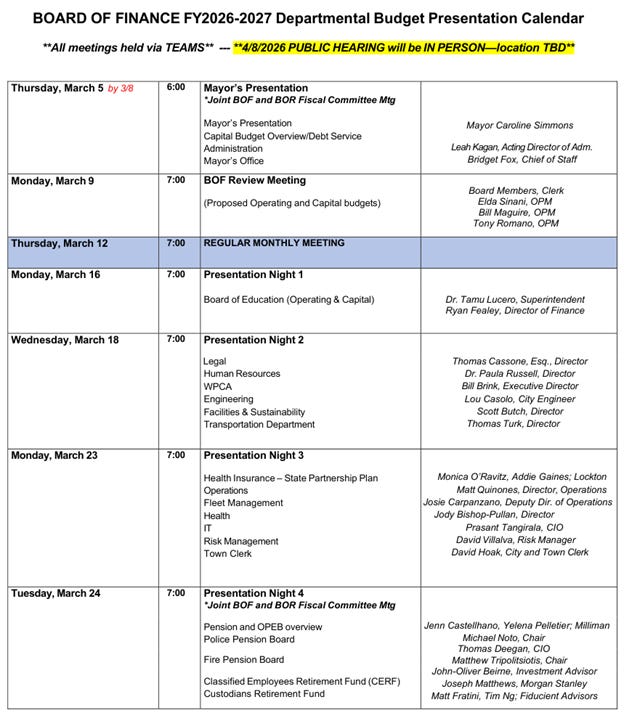
The coming weeks of hearings will determine the extent of cuts to the mayor’s proposed budget. The full schedule for the remaining budget process is available on the city’s website.
[1] Feather Ruffler is producing an explainer piece on Stamford’s municipal budget. It is difficult for an ordinary person to understand how to interpret the budget due to 1) poor reporting standards at the City of Stamford prior to FY2015, 2) a history of modifying budgets after fiscal years conclude, and 3) un-intuitive accounting tricks. Feather Ruffler talked to multiple local budget experts for this story and one background source stated “The budget is fucked up.”
[2] A budget surplus suggests the city is “overtaxing” residents. Historically, Stamford’s budget surpluses have been used to fund capital projects or pay down debt.