

At the housing town hall in Stamford on Jan. 13, State House Majority Leader Jason Rojas alluded to the defining divide in housing in Stamford.
“We have to be careful around the political messaging around [housing]. ‘Let’s build so much housing that the value of your home goes down.’ Not a winning message for the record,” said Rojas.
It’s the closest anyone will get to saying the issue of housing is divided by the “haves” and “have nots,” and our political system is built around serving the “haves” — people who have property and tend to be older and well established in life.
This is the emerging political divide in Stamford and across the United States. A division not by politics, but by generations. One generation has all the levers of government giving — or ensuring they get to keep — a lot of stuff. All the other generations are discovering they may never get the same.
Total Boomer Luxury Communism
The term being used to describe this system of government is Total Boomer Luxury Communism. It describes the consistent policy of extracting wealth from younger generations to benefit aging Baby Boomers. The term comes from “Fully Automated Luxury Communism,” which theorized a utopian Star Trek future where technological miracles provide luxurious living for all. The “Boomerism” variant keeps luxuries exclusive to one generation and lacks the ability to pay for them without taking from others.
Boomerism exists at the federal and local level. At the federal level, it’s debt. At the local level, it’s housing. We’ll get back to housing in a few paragraphs but let me give you context for where this term is coming from.
Russ Greene coined the term Total Boomer Luxury Communism (which I am short-handing as “Boomerism”) and the term has become a popular critique of both political parties’ failures to tackle budget issues.
The national debt has been a talking point for conservatives for decades and in 2024 national Republicans made a big deal about the national debt… then supported policies making it worse (tariffs, Big Beautiful Bill, kneecapping DOGE). “Boomerism” may come from the right’s ecosystem, but it shouldn’t be confused as a critique of “left” policies — or as a redux of the ordinary conservative argument “government spending is bad.”
Boomerism is defined by wealth extraction — taking tax revenue from younger generations to give government benefits only used by older generations. Government programs like unemployment and food stamps are not “Boomerism” because these programs are accessed — and paid for — by all generations. For many critics of Boomerism, the solution is not “cut all government spending,” but redistribute entitlements to support young families and business owners (who drive the economy that pays for these things).
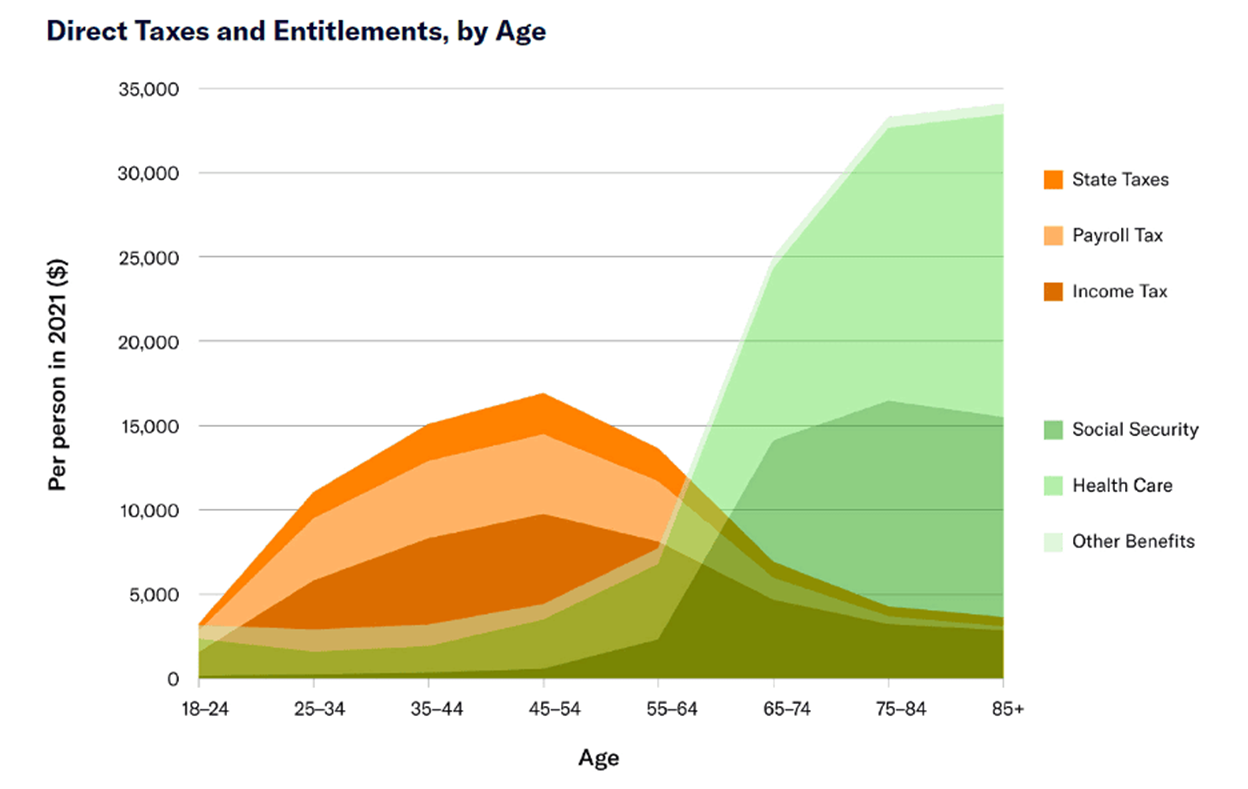
Boomerism is programs like social security and Medicare.
The average American over 65 will receive roughly $25,000 in net federal benefits, while the average American between 18-65 will pay roughly $8,000 for those programs. And no, people have not “paid in” to these programs to cover their own costs — partly because taxes are not structured that way and partly because there are way more Boomers then any other generation.
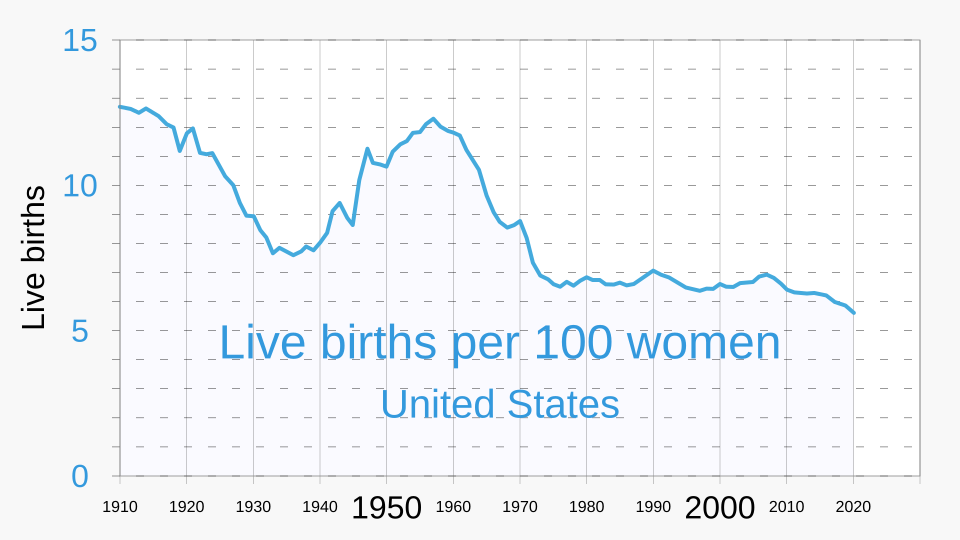
These programs include ludicrous luxuries.
Medicare Advantage pays for membership fees at ski resorts and golf clubs. Social security gives twice as much cash to recipients as similar programs in the UK, Canada, and Australia. Some households can collect up to $117k a year for decades.
This isn’t “welfare,” it is subsidized wealth.
Housing is the “national debt” of local politics
At the local level, the “subsidized wealth” is property valuations of single-family homes and tax policies subsidizing their ability to stay in $1M+ properties.
In any free market, the existence of an expensive good creates an incentive for a person or business to provide that good. This is basic “supply and demand.” If a lot of people want a good and there’s not a lot of that good then the price of the good is high. If a lot of people want a good and you make a lot of that good very quickly, the price of the good goes down.
Local governments frequently can’t make a lot of housing because of what Rojas referred to in Stamford’s housing town hall as “a thousand vetoes.”
In Stamford, zoning board decisions are politicized, zoning board members receive political retribution for voting for lawful projects, and entire political factions are dedicated to pulling every alarm to prevent development.
This is frustrating on its own, but it is uniquely frustrating in Stamford because we’re not building housing just for fun but because the city doesn’t have sufficient revenue to pay its debt.
It always surprises me how many people don’t know this. Stamford is only pursuing a pro-growth housing development strategy because the city owes $200M.
This problem was discovered by Mayor David Martin in 2014 and at the time it was getting significantly bigger every year. The increase was so dramatic he had this bit during the State of the City where he would present the typical “increased costs” of the operating budget and board of education, then he’d have to change the scale of y axis of the chart to show the increase cost of pensions and other post-employment benefits (healthcare).
When Martin says “the failure to consider the future has really changed the options that we have as a community,” that’s him using consultant-speak to say “we screwed up our financials so badly our only option is growth.”
Quick aside…
The growing cost of pension and healthcare benefits is why the Martin administration preferred overtime over new hires. Each new hire meant more costs to that bright red line in the video above — which we were already behind on by a significant amount. As Martin says: “even if [these costs] were eliminated tomorrow, we would still have a huge unfunded liability.” Overtime looks expensive now but it is better than adding debt to be inherited later by the next generation.
For example, Stamford’s Police Department had a lot of overtime. This resulted in some cops getting a lot more money — not because their base salary was $250k but because they took a lot of overtime.
Hearst Connecticut ran a number of incredibly annoying articles about city salaries where the top 10 were almost always police officers. This motivated rhetoric about “highly paid government employees,” in service to a broader argument about property taxes being too high — as if overtime costs are the main driver of tax increases. They’re not. Debt is. The additional revenue provided by development is the only reason we’re not seeing double digit tax increases.
Martin began including a breakdown of overtime costs when his administration sent salary data to Hearst, but that caused a delay in providing the data. Hearst filed a FOIA complaint against the city over this issue and lost. As far as I know, Hearst stopped publishing these articles — thank God.
Anyway…
A pro-growth housing development strategy means more revenue for the city to pay debt. This debt was mostly accrued by paying benefits to Boomers.
No growth means inflated valuations for homes. That means triple digit returns on real estate assets primarily owned by Boomers. If the city provided more housing supply, the cost of housing — and inflated housing valuations — would go down. This would reduce the valuations of homes for the generation that already has immense wealth while providing real rent decreases for younger generations.
When politicians say “lowering housing values is not a winning message” that’s only true if the majority of voters have housing valuations to lose.
Millennials have the political capital to affect change
Stamford is at the ground floor of this political argument because of the recent re-election of (Millennial) Mayor Caroline Simmons and the massive turnover in the Board of Representatives has changed the generational dynamic of our political leaders.
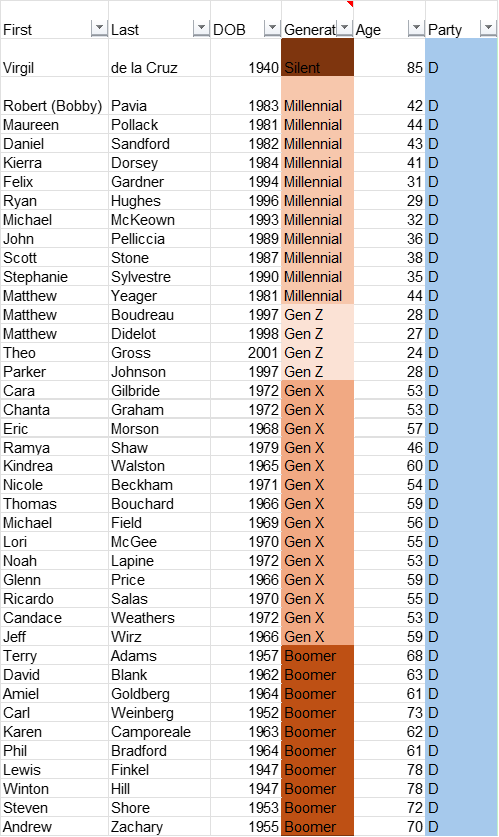
The new board’s average age reduced from 58 to 52 thanks to the election of more Millennials (11 up from 6) and Gen Z (4 up from 0) while replacing Boomers (10 down from 16) and Silents (1 down from 3). Gen X maintained its level of representation. Many of these representatives are new to the board.
Both the old and new board are overwhelmingly Democrats, but the previous board was antagonistic toward its own Democrat mayor because housing is divided by generation — not politics.
The city’s recent political melees over the Glenbrook Community Center, the charter, and the master plan were all about housing. The tactics opposing housing prefer access to backrooms over the fairness of laws (hence the “Communism”). This is how the board blocked dozens of appointees and organized the most aggrieved property owners in the city to oppose housing.
Stamford’s Democratic City Committee (chaired by Gen Xer Robin Druckman) mobilized and ousted almost everyone associated with Boomerism in Stamford. The new board is mostly newcomers, but that doesn’t mean Boomerism won’t return.
It’s worth clarifying: “Boomerism” isn’t necessarily supported by every Boomer; not every Boomer benefits from “Boomerism”; and not all supporters of Boomerism are Boomers.
Anyone who owns property in Stamford has incentives to support the wealth extraction system associated with Boomerism. Politicians also have incentives to support wealth extraction — evident in the fact Mayor Simmons has already supported it in her first term.
Stamford’s wealth extraction of younger generations
Every 5 years, Connecticut municipalities perform a “re-evaluation” of all properties in the city. This frequently shifts the tax burden depending on how neighborhoods have changed since the last “reval.”
Stamford’s 2022 re-evaluation showed multifamily homes (such as apartments and condominiums) became less valuable while single-family properties (such as the typical home in the suburbs) became more valuable. This is consistent with development of multifamily properties and no development of single-family properties (produce more of a good = the value of that good goes down).
The revaluation meant single-family properties – predominantly owned by Boomers – would be taxed at a higher rate. Multifamily properties – predominantly owned by younger generations – would be taxed at a lower rate.1 An unacceptable tradeoff for Boomerism.
The city passed a proposal to delay the new tax rates — extracting wealth from the young to give more to owners of multi-million dollar properties. Textbook Boomerism. Approved and implemented by Simmons.
A similar dynamic appeared with the master plan. City staff proposed more housing in a district adjacent to downtown. Boomerism opposed it. Simmons caved.
That’s because Boomerism is popular. You don’t need to be a Boomer to support Boomerism, but for most of Stamford’s history Boomers were the largest voter demographic. That changed last year.
There are now more Millennial registered voters than any other generation.


The margin is thin and this has only been true for a handful of months, so we’re still frozen in the status quo.
The status quo is Democrats refuse to cut anything from government spending or control (such as environmental or equity assessments that often block housing development), and Republicans talk about literally limiting property taxes. Both political parties are designing policy around Boomers.
The only way to overcome these entrenched interests would be a local government detached from national politics, with a new board, and a leader with no threat of opposition. Simmons’ historic trounce of all opponents has delivered that circumstance.
Ironically, the previous board’s resistance to development by blocking all appointees to boards associated with development has gifted Simmons a rare opportunity. Simmons could completely redesign powerful land use boards simply because there are so many positions to appoint. According to Chief of Staff Bridget Fox, the city plans to submit more than 30 appointees in January.
These appointees could turn on the faucet of housing development and accomplish real rent decreases within the next 4 years. There is nothing stopping our newly re-elected mayor from addressing the number one issue for the largest voting demographic in Stamford.
The only question is if she is willing to mobilize a new voter base or rely on appeasing the old one.
Multifamily properties are mostly apartments, which young people do not “own,” but they pay rent. The cost of rent is heavily influenced by how much it costs to maintain the building and annual property taxes are a big contribution to that “maintenance” cost. Additionally, condominiums are classified as multifamily and typically “owned” in a traditional sense.