

Editor’s Note: If you haven’t checked Feather Ruffler in a bit we’ve backdated Board of Representatives roundups for June and May earlier this year.
STAMFORD — The Board of Representatives voted 35-2 on Monday night to send an ordinance requiring the mayor’s office to report data about applicants to the city’s boards and commissions to a second public hearing, over the objection of Representative Carl Weinberg, who called the measure “unnecessary and burdensome.”
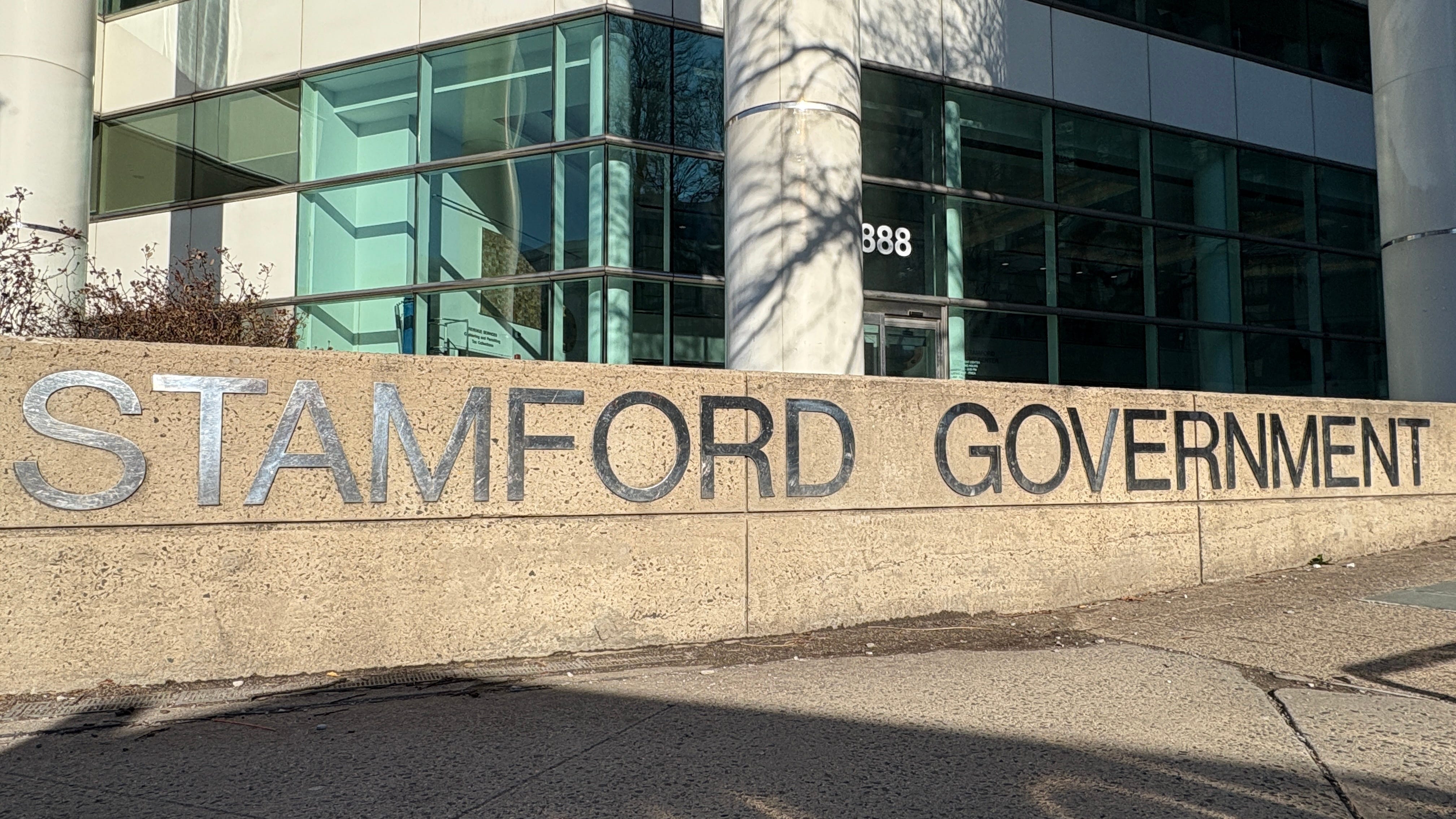
The vote for the ordinance to receive a second public hearing was the most debated item of the board’s July 6 regular meeting at the Government Center — which opened with Mayor Caroline Simmons’ 2026 State of the City address. Feather Ruffler covered the State of the City address in a separate article.
Reporting ordinance advances to a second hearing
The ordinance (LR32.017, discussion begins at 1:01:14) — submitted by Representatives Michael McKeown and Karen Camporeale — would require the mayor’s office to report data each quarter about the people who apply to serve on Stamford’s volunteer boards and commissions. The report would cover three groups: everyone who applied, everyone interviewed by a city official, and everyone nominated before the Board of Representatives.
Applicants would be required to provide their name, address, voter registration status, and voting district. They could optionally disclose their ethnicity, gender identity, political party, age, education, occupation, and languages spoken. The report must present the data in an aggregate, anonymous form that cannot identify any individual. The ordinance would also require the mayor’s office to notify the board president of any seat left vacant — or occupied by an appointee whose term expired — for more than 120 days. Willful violations of the reporting requirements would count as violations of the city’s Code of Ethics.
The appointments process was the center of a multi-year political fight between the previous Board of Representatives and multiple mayoral administrations — including a failed 2023 charter referendum that would have given the board power to fill seats with expired terms. Feather Ruffler published an explainer on how Stamford’s appointments process works.
The Legislative and Rules Committee amended the ordinance in June to require quarterly rather than monthly reports before approving it 8-1. Monday’s vote sends the proposed ordinance to a second public hearing. A date for the hearing was not announced at the meeting.
“To clarify […] this is a vote in favor of bringing [the ordinance] for a second public hearing, but not to approve it,” said McKeown.
Weinberg — who chairs the Personnel Committee that interviews the mayor’s appointees — was the only representative to speak against the ordinance. He said the amendment in the L&R Committee from monthly to quarterly reports was an improvement but the data would “focus on the wrong subject.”
“I still consider the ordinance to be unnecessary and burdensome for the mayor’s office, but more significantly, I also believe that the required data in this ordinance will encourage the board of reps and the public to focus on the wrong subject,” said Weinberg. “It will encourage the board to focus on the mayor’s decisions not to nominate certain candidates, not on why we have a dearth of candidates from certain neighborhoods in the city and from certain demographic groups and from women.”1
McKeown responded that the ordinance’s design prevents the misuse Weinberg described.
“The ordinance specifically prohibits the compilation of the data in any way that would meaningfully identify any individual,” said McKeown. “It is aggregate anonymous data that wouldn’t allow this body to draw conclusions with respect to individual nominees or individual applicants.”
Representative Cara Gilbride also voted no but did not speak on the merits of the ordinance, according to the meeting’s action report, the board’s official minutes document.
A companion ordinance (LR32.016) that would repeal the city’s dormant Appointments Commission was postponed by the committee so both items can be considered together at next month’s meeting.
Former representative: North Stamford roads are neglected
During the public comment period (comments begin at 45:17), former District 19 Representative Don Mays said North Stamford residents receive poor service from the city’s road maintenance operations — which are managed by the Department of Operations.
“My neighbors don’t feel safe walking, running, or cycling along the roads because the road surfaces in the shoulders or the right of way sections are not regularly maintained,” said Mays. “It’s not good enough for the city to just patch an occasional pothole or repave only the worst roads in our area.”2
Mays listed maintenance work he said the city neglects: cutting back overgrowth that narrows lanes, repairing curbs broken by snow plows, street sweeping to clear gravel that endangers cyclists and clogs storm drains, removing dead trees and storm debris from the right of way, repainting road lines, replacing damaged signs, and installing guardrails at steep drop-offs.
Mays requested the board’s Operations and Public Safety committees hold a joint review of road maintenance operations, and asked the board to amend Chapter 214 of the city ordinances to make clear the city is accountable for maintaining the right of way on road shoulders.
“When I was in office, I met with the mayor, I met with the operations director, I met with the road maintenance supervisor about these issues to no avail,” said Mays. “Nothing has changed. I hope you can do better.”
Other business
The board approved nine appointments on the consent agenda (A32.046 through A32.054, reports begin at 55:42), including five new members of the Fire Commission.
The board accepted a $324,646 federal grant (F32.089) from the Substance Abuse and Mental Health Services Administration — through the Recovery Network of Programs — to cover salary and fringe costs for a police officer assigned to the Stamford Police Department’s Behavioral Health Unit.
The board unanimously approved an employment contract for Diversity, Equity and Inclusion Officer Janeene Freeman (P32.009). Freeman joins Director of Economic Development Leah Kagan and Deputy Director of Operations Josephine Carpanzano as a former Special Assistant to the Mayor who was later hired by Mayor Caroline Simmons for a position created during her administration.
The board’s next regular meeting is Monday, August 3 at 7:30 p.m.
Rep. Weinberg continued: “Why do I think that’s what will happen? Because that’s what most of the comments in support of the ordinance are focused on. Instead, we should be focusing on what is causing the disparities in gender, districts, and ethnic groups on the city’s volunteer boards and commissions. A better course than this ordinance would be to request the application data from the mayor’s office on a one-time basis, so we see what it says. I’m sure that the mayor’s office would provide such data, and then we could analyze it to understand the root causes of the membership disparities. If we do that, we’ll actually be working on the underlying problem instead of just beating around the bush.”
Mays full public comment: “My name is Don Mays. I am a resident of North Stamford and the former District 19 representative. Tonight, I’d like to draw your attention to the poor service that North Stamford residents have been getting from the city’s road maintenance department. We believe that our part of the city is being neglected and people are fed up with the poor conditions of our roads. My neighbors don’t feel safe walking, running, or cycling along the roads because the road surfaces in the shoulders — or the right of way sections — are not regularly maintained. It’s not good enough for the city to just patch an occasional pothole or repave only the worst roads in our area. Proper road maintenance is much more than that. It requires regularly cutting back the overgrowth that encroaches over the road surfaces — narrowing the lanes and making it difficult to see around corners. It’s dangerous for drivers and pedestrians. Proper road maintenance requires properly repairing broken curbs that get ripped apart each winter by the snow plows. It’s now July and our curbs are still a mess. The city needs to replace them and backfill with soil, so they don’t get broken time and time again. It requires regular street sweeping to clear the loose gravel and storm debris that make it dangerous for cyclists and clog storm drains and catch basins resulting in flooding. It requires cutting back tree branches that obscure road signs and cutting down dead trees along the right of way sections and clearing the right of way sections of the debris that just gets piled up there after a storm — never to be removed. It requires repainting the road lines and replacing worn, damaged, and crooked road signs that make our area look neglected. It requires holding cable companies responsible for cleaning up their mess of coiled cables they leave on the ground. It requires installing guardrails where there are steep drop-offs on the road shoulder, so don’t tell me that the Fix-It system is the solution. There are far too many problems to relegate to fix it, and many fixing complaints go unanswered. These are systematic problems that need to be addressed proactively by the city. We need regular monitoring of our road conditions and regular maintenance. When I was in office, I met with the mayor, I met with the operations director, I met with the road maintenance supervisor about these issues to no avail. Nothing has changed. I hope you can do better. I’m requesting that the operations and public safety committee hold a joint review of our road maintenance operations and insist on operational and safety improvements. Furthermore, requesting the legislative body amend chapter 214 on the city ordinances, making it perfectly clear that the city owns the right of way on the road shoulders and should be held accountable for their maintaining it.”