

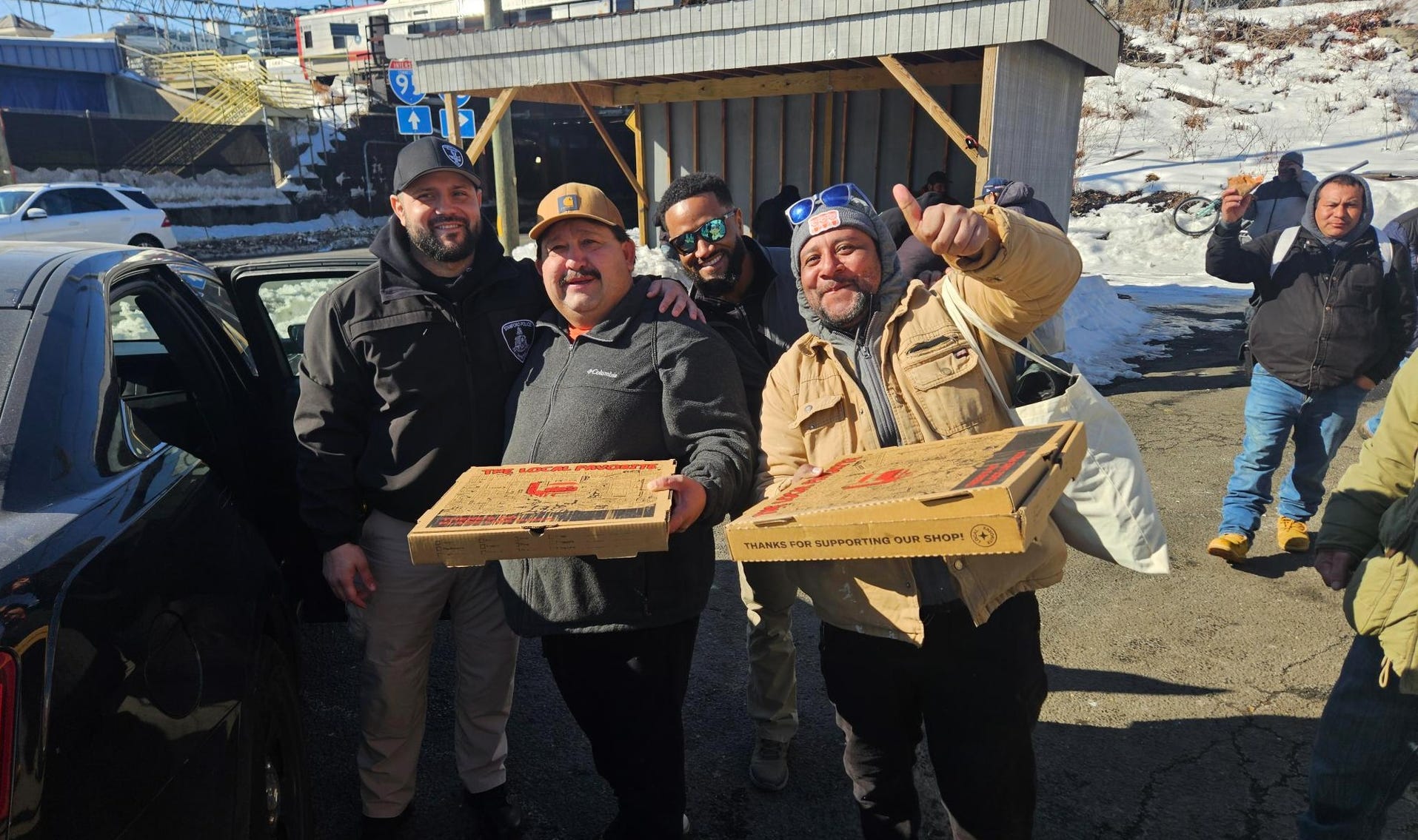
STAMFORD — After a storm dropped 12 to 18 inches of snow on January 25th earlier this year, Stamford’s average temperature remained below freezing for more than two weeks — frequently dropping to single digits at night. In New York City, 18 people died in the cold. In Stamford, they got coats.
“We noticed that there were a lot of individuals — a lot of the homeless and individuals that are really in need of coats — and they were not coming forward,” said Stamford Police Department’s Lieutenant Jerry Junes. “So we went out into the community and started seeking individuals that really needed assistance, needed coats and blankets, specifically the homeless population.”
Junes oversees Stamford Police Department’s (SPD) Community Outreach Team (COT) — a volunteer cross-departmental unit focused on maintaining engagement between SPD and the public. The Community Outreach Team runs the “Warm Stamford” initiative, which provides donated coats to people on the streets of Stamford as a way to introduce residents to local services.
The team distributed more than 200 coats across six outreach events hosted between late December and mid-February, according to Junes. These events frequently included other warm clothing such as blankets, scarves, gloves, as well as coffee or pizza.
Warm Stamford is provided at “no cost,” according to Junes.
The Community Outreach Team has no personnel costs because it is made up of 22 police officers already assigned to other teams within SPD. These officers volunteer their time to COT in addition to existing responsibilities. For example, Junes is assigned to the department’s Behavioral Health Unit (BHU) and oversees its school resource officers. His involvement in the COT is in addition to his typical work.
The clothing and other items are donated by the public. Pizza and coffee is donated by a local business owner who has contributed to the program for years.[1] Winter clothing is donated by other police officers, the Veterans Resource Center, and occasionally the public. Although Junes hasn’t requested donations in a while.
“The last time I did that we had about 800 coats that were dropped off in one day,” said Junes. “It was just too much to handle.”
“We went out into the community”
The Community Outreach team isn’t new, but its current iteration is an evolution of what existed prior to 2015. In the previous model, officers were assigned to a “community policing team.” These officers were given a specific neighborhood to handle community issues like blight, drug activity, or general community relations. These neighborhoods tended to be on the West Side or South End — which have historically had more demand for police resources.
The current model of the Community Outreach Team was implemented in 2015 and it works differently. The volunteer officers associated with COT are pulled across multiple departments including detectives, patrol, behavior health, youth services, and others. Each officer is mobilized for a community policing initiative based on the identified needs. The team reports its activities to the Chief of Police on a monthly basis which sometimes results in intelligence provided to relevant divisions within the department.
For information about the Stamford Police Department’s public safety structure, see Feather Ruffler’s explainer on Stamford’s Department of Public Safety.
Some version of the “Warm Stamford” initiative has been around since 2008, when the department began collecting coats internally. But what is new this year is the strategy of how to distribute these resources to residents.
For this winter season, Junes said instead of waiting for people to come to them, police officers went out to where homeless individuals tend to gather.[2] This approach is an extension of the Stamford Police Department’s philosophy of “community policing.”
Originally conceived in the United States during the high crime of the 1960s and 1970s, “community policing” was formally outlined after congress passed the Violent Crime Control and Law Enforcement Act in 1994. The Department of Justice’s memo on community policing defines it as “a collaboration between the police and the community that identifies and solves community problems.”
Junes said the term is applied in everyday interactions.
“Every time you get out of your patrol car or truck and you walk into a coffee shop, saying good morning to people, shaking somebody’s hand, hold [sic] a door open for someone… that’s like the foundation of what policing is really about — or what it should be really about,” said Junes. “Does that happen all the time? No. But it’s just that we should be doing it all the time.”
These community interactions build trust between officers and the public. These relationships provide officers with information — and community members with resources — to resolve problems together. Or in the words of the DOJ’s memo, “a foundation of trust will allow police to form close relationships with the community that will produce solid achievements.”
Officers working with the Community Outreach Team wear a deliberately casual uniform — khaki pants and a t-shirt that says “Stamford Police” on the back. Junes says the uniform is “softer” and “more inviting.” This is the uniform officers wear when they approach people on the street to offer warm clothes or food.
Before police can make contact with these people, they need to know where they are — which is provided through coordination with local nonprofits and other service providers.
What services are there for homeless people in Stamford?
Stamford Police Department’s community initiatives are one piece of a broader ecosystem of services in the city. With an estimated 150+ homeless people in Stamford at any given time, their needs can be very different case by case.
Some of these service providers focus on integrating within a local populace to understand the community’s needs. For example, Building One Community was originally founded in 2011 to provide services to “day laborers” in the city. The nonprofit coordinates with the Community Outreach Team to share information about this population's needs.
Other services are provided to the individuals who engage with COT. For example, Junes’ is frequently involved with coordinating between his own Behavioral Health Unit within SPD and Stamford Health — which operates Stamford Hospital.
“Historically, law enforcement encounters with those suffering from behavioral health issues ended at the Emergency Department,” said Chief Safety Officer for Stamford Health Joe Hines. “The patient would receive appropriate care and treatment and be discharged. Then, if the patient had another crisis in the community, the process would start over again from square one.”[3]
After the BHU was founded in 2021, Stamford Health gained a channel to communicate with SPD to get a better understanding of an individual’s needs and provide better care.
“If a person has a behavioral health crisis in the community, SPD’s BHU is often familiar with them,” said Hines. “They can more quickly understand catalysts for the crisis and provide support in the community.”
Stamford Health provides medical and behavioral assistance, but some people just need shelter.
For homeless men in need of shelter, the primary provider in Stamford is Pacific House. Located on Pacific Street, Pacific House operates an emergency shelter 24 hours a day, 365 days a year, serving roughly 60 to 85 men per night. Pacific House provides shelter, but also meals, case management, job training, and substance abuse recovery programs.
For homeless women and families in need of shelter, the primary provider in Stamford is Inspirica. Inspirica provides two locations. A family-centered facility on Franklin Street and a women’s shelter on Woodland Place. Inspirica’s network of facilities across lower Fairfield County house roughly 500 people per night.
Does helping the homeless keep Stamford safe?
Stamford has long been considered one of the safest cities of its size in the country. The city’s population of more than 135,000 has been bolstered in recent years by an influx of residents from New York City. The arrival of these residents creates a population acutely aware of public safety as a quality-of-life factor for where they live.
Junes acknowledge some residents may hear about a program assisting homeless people and question if it invites a larger homeless population to the city. This is known as “magnet theory,” the idea a city with generous services will attract people from outside the city.
“While we have just over [150 homeless people], that’s not a lot in the big scheme of things,” said Junes. “We have had a lot of homeless people that we’ve worked with and now have apartments and are in work programs. I bet if we didn’t do what we do, we would have more homeless people on the street.”
Research from across the political spectrum does not support “magnet theory” for the services provided by the Community Outreach Team.
A study done by the University of Washington found homelessness is not correlated with availability of services, but is correlated with housing costs. The study showed areas with high poverty rates tend to have lower rates of homelessness because housing in these areas also tend to be cheaper.
An analysis by the U.S. Government Accountability Office found a $100 increase in a community’s median rent is associated with a 9 percent increase in homelessness. Stamford’s median rent is estimated at $2,800 or roughly 50 percent above the national average.
Another study done by the Cicero Institute — a right-leaning organization — concluded offering permanent free housing does attract homeless populations. However, no permanent free housing is offered in Stamford.
Pacific House and Inspirica did not respond to requests for comment.
[1] When asked to identify the business owner, Junes claimed the business owner “didn’t want any notoriety.”
[2] Junes said the “Warm Stamford” initiative focuses on the homeless population, but it is not exclusive to Stamford’s homeless population.
[3] Full Comment from Joe Hines: “First let me say that we at Stamford Health feel very fortunate to have the Stamford Police Department (SPD) as a partner in providing the highest level of health and safety for our community. Our goal in coordinating with SPD in general, but also specifically with the Community Care Team (CCT) is to continue to challenge how we do things and collaborate to improve outcomes. Historically, law enforcement encounters with those suffering from behavioral health issues ended at the Emergency Department (ED). The patient would receive appropriate care and treatment and be discharged. There was never any loop closure or consistent, ongoing coordination. Then, if the patient had another crisis in the community, the process would start over again from square one. Now, with consent from our patient(s), we can communicate with SPD’s behavioral health unit (BHU) to get a better understanding of the crisis they are experiencing and provide a more sustained continuum of care. Additionally, if a person has a behavioral health crisis in the community, SPD’s BHU is often familiar with them, so they can more quickly understand catalysts for the crisis and provide support in the community.”