

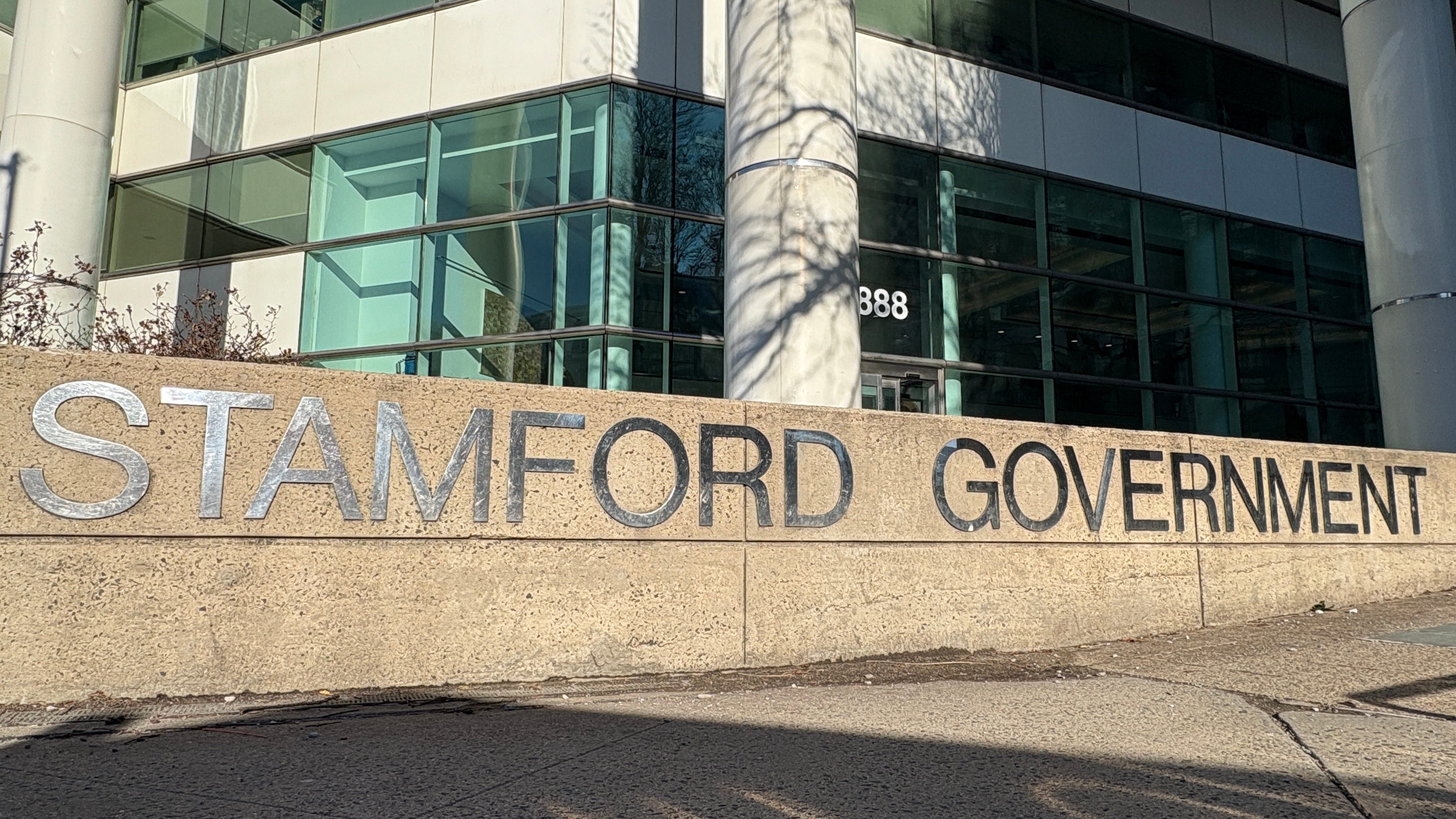
STAMFORD — The Board of Representatives voted 27-5 with six abstentions on June 1 to approve the sale of the former Midas site at 41 Main Street (LU32.008), clearing the way for a 55-unit below-market-rate apartment development on the city-owned lot.
The vote ended the longest debate of the board’s June meeting, which also saw approval of a lease for a school bus depot on Courtland Avenue, approval of $2.1 million for the redevelopment of St. John Towers, and the rejection of a $125,000 feasibility study for a public boat launch at Kosciuszko Park.
Housing: Midas site sale approved after failed push for a second public hearing
The sale of 41 Main Street (LU32.008, discussion begins at 01:51:56) sends the vacant auto repair property to a developer identified during debate as McClutchy. Representatives cited a $250,000 sale price with a $15,000 deposit during discussion. The vote approves only the sale of the land — the development itself must still go through the planning board and zoning board, which will hold their own public hearings.
Opposition centered on public notice. A public hearing on the sale was held May 21 and no member of the public attended. Representative Nicole Beckham — who represents the surrounding district — asked the board to hold the item for a second hearing. She suggested the public did not know about the first public hearing.
“These buildings are old school buildings, you really have to go knock on the doors, slide the flyers under the door, so at best they were never really given a fair opportunity to come out and voice their opinion,” said Beckham.
Representative Kindrea Walston supported a second hearing and said the neighborhood’s residents would not learn about the sale through official channels, adding that “silence doesn’t mean consent.”
“Everybody’s not tech savvy. The people living in that neighborhood, there need to be flyers in the lobby, flyers put underneath their door, so that they can come out and speak, or better yet, you can take it to them and go to their meeting area,” said Walston.
Representative Ryan Hughes, whose district includes the site, argued the vacant lot was the greater harm and connected the project to the city’s housing costs.
“The reason why housing, by and large, in Stamford, whether you’re buying a home or you’re renting, is unaffordable — it’s because of supply,” said Hughes. “We live in a great community with access to great jobs, great hospitals, great schools, great restaurants, great people. Who wouldn’t want to live here? There’s strong demand. When you have a lack of supply, which is what we have — a lack of housing of all types, not just below market — you create scarcity, and when that scarcity happens, landlords and these corporations that own these apartments can charge more.”
Hughes said the average rent in downtown Stamford is $2,700 and that the 55 units would rent below market rate.
Representative Noah Lapine disputed the notice argument, saying the proposal was publicly before the planning board on April 28 and publicly listed for the hearing by May 11. Clerk Parker Johnson agreed the city’s notification process is flawed but said it is governed by state law and the city charter, and a second hearing would follow the same process — no signs, no flyers.
A motion by Representative Adams to send the sale back to the steering committee failed 16-21 with one abstention. On the final vote, Representatives Beckham, Dorsey, Graham, Hyatt, and Walston voted against the sale, according to the meeting’s action report, the board’s official minutes document; Representatives Adams, Camporeale, de la Cruz, Hill, Sylvestre, and Weathers abstained.
Part of the objection concerned how the “affordable” units will be priced. Beckham urged the board to study low-income housing tax credit properties before voting.
“When our constituents hear affordable housing, they’re used to Section 8 vouchers, where your rent is based on 30% of your income. Tax credit properties, the rents are based on the area income and not the resident’s income,” said Beckham.
Beckham’s description is accurate. In a low-income housing tax credit (LIHTC) property, rents are set as a fixed amount tied to the area median income — the median income of the wider region, not the individual tenant. A tenant at the bottom of the qualifying income window pays the same rent as a tenant at the top of it, and tenants whose income rises above the window no longer qualify. Under a Section 8 voucher, by contrast, the tenant pays roughly 30% of their own income and the voucher covers the rest. The Midas site development will use the tax credit model, which is why Walston argued the units are affordable but not “deeply affordable.”
Courtland Avenue school bus depot lease passes 35-4
The board voted 35-4 to approve a city lease of 0 and 338 Courtland Avenue for school bus parking (LR32.018, discussion begins at 01:21:56). The site is currently occupied by Paramount Stone, with the adjacent parcel running along the train tracks. Representatives Gross, Hughes, Price, and Yeager voted against, according to the meeting’s action report.
Representative David Blank, relaying information from the committee meeting, said the depot would hold up to approximately 90 buses and is intended to reduce the city’s dependence on First Student, the district’s current bus contractor. He said a traffic study found little effect on overall traffic in the neighborhood.
“The bus depot will allow for us to get a better service for our schools at a lower cost than First Student is willing to do, and bring us into compliance with regards to GPS tracking and other issues that are outstanding with First Student,” said Blank.
Representative Gross opposed the lease, arguing Courtland Avenue is already one of the busiest roads on the East Side.
“School gets out at 2 o’clock. These buses are going to be returning four or five o’clock when Courtland Avenue is really at its busiest,” said Gross.
Representative Matthew Boudreau responded that buses would mostly pass through before peak commuting hours and that Courtland Avenue, a state road, is built to a higher standard than the residential streets where buses currently park. Walston, who supported the lease, said the West Side needs relief from buses currently parked on Bonner Street, a residential street.
The lease previously passed the Board of Finance 6-0 and the board’s Legislative and Rules Committee 9-0. During public comment, District 12 resident David Berman said the lease runs 15 years and includes a right of first refusal for the city, and asked what Stamford will own at the end of the term.
Kosciuszko Park boat launch study fails 10-26
An additional appropriation of $125,000 for a feasibility study of a public boat launch (F32.082, discussion begins at 00:52:14) on the Stamford Harbor shoreline at Kosciuszko Park failed 10-26 with three abstentions. A companion resolution authorizing an agreement with the Connecticut Port Authority (F32.083) then failed 2-36. The study’s supporters were Representatives Didelot, Gardner, Gilbride, Johnson, Morson, Price, Sandford, Shaw, Weinberg, and Wirz, according to the meeting’s action report; Representatives Bradford, Pollack, and Zachary abstained.
Majority Leader Eric Morson, who supported the study, said none of the money was city funded: half came from a 2022 state grant and half from a 2019 private donation to the Harbor Management Commission restricted exclusively to water use.
“As this was a restricted donation, the money can’t be used for anything in the park other than water use,” said Morson.
Opponents argued the spending sent the wrong message after a difficult budget season.
“We said to many nonprofit organizations that there were requests for four or six hundred dollars to address areas of public service, homelessness, food scarcity, etcetera, were simply not going to be approved because the city of Stamford couldn’t afford it,” said Parliamentarian Michael McKeown. “In the same budget cycle, we reduced a budget for architectural plans to build a library on the East Side by $100,000.”
McKeown also said no one could tell him what the eventual boat launch would cost or where that money would come from.
Representative Karen Camporeale rejected the argument that the study money was free, and argued the private funder’s willingness to pay for a study suggests they already have an idea of the project’s final cost.
“Grants that come from the state are actually our tax dollars,” said Camporeale.
Representatives Graham and Walston, who represent the South End, said the park itself needs investment before the city studies adding a boat launch — citing broken lighting, air quality problems, traffic, and conflicts between boaters and families using the park.
During public comment, South End resident Sue Halpern said a $100,000 request from the parks director to upgrade the park’s parking lot, pathways, and lighting was denied this budget cycle.
“Studying the feasibility of a public boat launch seems dismissive of the long-standing maintenance concerns of this former landfill,” said Halpern, noting 14,000 people live on the peninsula.
Representative Cara Gilbride — who supported the item — told the board “free money is free money” and objected to a suggestion by Hughes that a boat launch would mostly serve the wealthy, inviting colleagues to visit the city’s Czescik Marina to “see the diversity that is there.”
Housing: $2.1 million approved for St. John Towers redevelopment
The board approved a $2.1 million allocation to Heritage Housing, Inc. and the St. John Urban Redevelopment Corp (CHESS32.014, discussion begins at 02:58:07) to redevelop 305 units of affordable housing at the St. John Towers property.
The item was approved through an unusual mechanism: the board voted not to reject it. Under the city charter, certain items come before the board only as “rejection items” — the board cannot vote to approve them, only to reject them or let them stand. To approve the $2.1 million, representatives had to vote down the rejection, a double negative that produced several minutes of confusion during the voice vote. The board’s committee had previously declined to reject the funding 0-8.
In layperson terminology: the funding for the redevelopment of affordable housing units was approved.
Other business
Two related ordinances on the city’s appointments process were both advanced to public hearings, with final votes expected at a later meeting.
The first, an ordinance establishing reporting requirements on board and commission appointments (LR32.017, discussion begins at 01:40:55), was approved 37-2 and would require the Mayor’s Office to report data on applicants and appointees to the city’s boards and commissions. It was submitted by Representatives McKeown and Camporeale. McKeown said the ordinance only requires reporting of data the administration already collects.
During public comment, resident Dave Adams said appointments transparency has been a live issue through multiple charter revision commissions and boards of representatives, including two ordinances passed by the 31st board that were vetoed.
“While the charter defines co-branch responsibility on this matter, there’s absolutely no accountability for these appointments to the various boards, commissions, to the public,” said Adams.
The second, an ordinance repealing the Appointments Commission (LR32.016, discussion begins at 01:47:44), was approved unanimously. The commission is a separate body from the board’s own Appointments Committee, and the repeal was submitted by Mayor Caroline Simmons.
McKeown said his understanding of the administration’s position is that the commission achieved its original mission of increasing representation of unaffiliated and independent voters and no longer adds value to the process. Boudreau said in committee that his support for the repeal was contingent on the reporting ordinance passing, so the existing oversight structure is not eliminated without a replacement.