

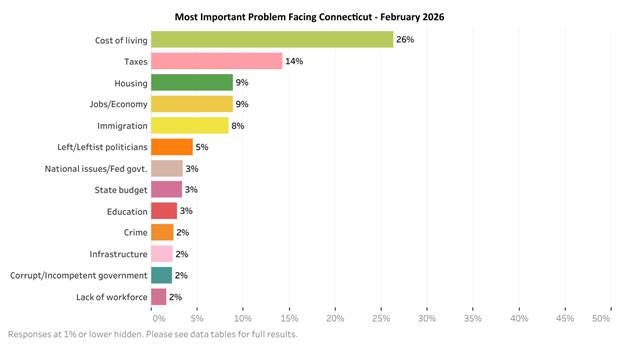
HARTFORD — The cost of living is the single most important issue facing Connecticut, according to Nutmeg State Poll conducted by the University of New Hampshire.[1] Candidates vying to replace incumbent Democrat Governor Ned Lamont have taken notice by focusing on how to bring costs down for Connecticut residents.
The Nutmeg State Poll, conducted between Feb. 12 and Feb. 16 among 583 Connecticut residents, found 26 percent of respondents named the cost of living as the most important problem facing the state. Taxes came in second at 14 percent, followed by housing and jobs, each at 9 percent.
“Cost of living” is another way of saying “affordability” which became a major focus for national politicians in 2025. All candidates are focusing on ways to reduce the cost of living for Connecticut residents, but have been received differently by their own voters.
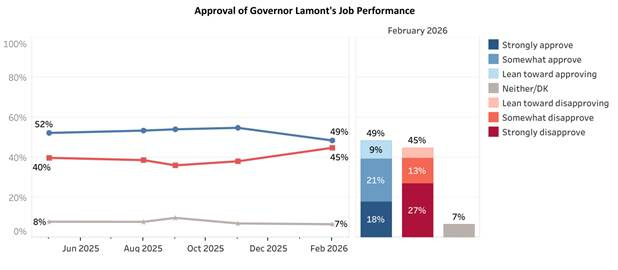
Lamont holds a comfortable lead — but his approval has slipped
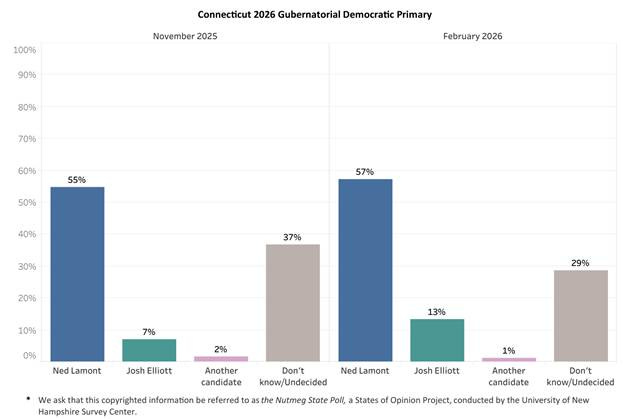
The poll found 57 percent of likely Democratic primary voters would vote for Lamont if the primary were held today, compared to 13 percent for his challenger State Representative Josh Elliott, and 29 percent undecided. That represents a slight improvement for Elliott from November, when he polled at 7 percent.
According to the poll, Elliott’s support is concentrated among the party’s left flank. Twenty-five percent of progressives and 20 percent of socialists support his candidacy, compared to 5 percent of moderates and 4 percent of liberals.[2]
Lamont remains broadly popular among likely Democratic primary voters, with 54 percent holding a favorable opinion. His approval rating among all Connecticut residents has dipped to 49 percent approve and 45 percent disapprove — a net approval of +4, down from +17 in November. Approval of Lamont among specifically Democrats has fallen from 86 percent to 76 percent since November 2025.
Lamont’s decreased approval rating from November coincides with his announcement that same month to seek a third term. The prior poll took place before his announcement.
Elliott, 41, represents Hamden’s 88th House District. He was first elected in 2016 and currently serves as deputy speaker. He previously ran for secretary of state in 2022 before dropping out after the nominating convention.
Fazio leads the Republican field with the highest favorability and fewest detractors
Among likely Republican primary voters, State Senator Ryan Fazio holds the strongest favorability rating of any Republican candidate in the field. According to the poll, 42 percent of likely Republican primary voters have a favorable opinion of Fazio, 16 percent are neutral, and 3 percent view him unfavorably. Another 39 percent said they don’t know enough about him to have to say — giving him a net favorability rating of +39.
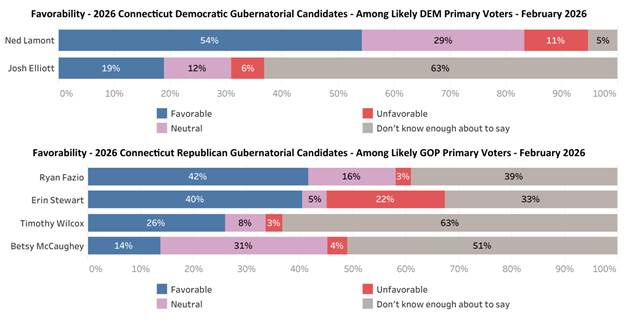
Favorability at a glance:
Ned Lamont. Net +43 among likely Democratic primary voters
Josh Elliott. Net +13 among likely Democratic primary voters
Ryan Fazio. Net +39 among likely Republican primary voters
Erin Stewart. Net +18 among likely Republican primary voters
Former New Britain Mayor Erin Stewart is close behind in raw favorability at 40 percent, but her unfavorable rating is significantly higher at 22 percent. Her net favorability of +18 is roughly half of Fazio’s. Political activist Timothy Wilcox and former New York Lieutenant Governor Betsy McCaughey trail further behind, with majorities of likely Republican primary voters saying they don’t know enough about either candidate to have an opinion.
The Republican primary is scheduled for August 11, 2026.
Fazio, 35, represents Connecticut’s 36th Senate District, which covers Greenwich, parts of Stamford, and New Canaan. He is the Ranking Senator on the Energy & Technology Committee and the Finance, Revenue & Bonding Committee. Originally elected in a 2021 special election, he won a close re-election in 2022 and again 2024.[3]
Stewart, 38, served as mayor of New Britain for 12 years across six terms, making her the city’s longest-serving Republican mayor. She was first elected at age 26 in a city where Democrats outnumber Republicans four to one. She ran for governor in 2018 and later ended her campaign to run for lieutenant governor but did not win the party’s endorsement.
Candidates focus on affordability with energy policies
Fazio’s gubernatorial campaign continues policy proposals he pursued as a State Senator. As a state legislator, Fazio focused on policies addressing electricity costs in Connecticut. He proposed cutting the “Public Benefits Charge,” a line item on utility bills used to fund state energy and environmental programs. As a candidate for governor, Fazio’s campaign proposes expanding the state’s natural gas pipeline, cutting renewable energy subsidies, and ending state programs that subsidize electricity demand — in addition to cutting the Public Benefits Charge.
Stewart, by contrast, has not released a comparable policy document. Her campaign messaging has focused on the broader theme of affordability and “real talk” about Connecticut’s direction. However, a campaign advisor for Stewart referred to Fazio’s energy plan as “reheated soup,” despite Stewart submitting testimony in support of the policies in 2025 and investing $200k into television ads where she states: “I will end the public benefits charge.”
On the Democrat side of the race, Elliott has taken the opposite position to many of Fazio’s proposals. His campaign proposes ending state support for natural gas, expanding renewable energy projects such as rooftop or community solar, and amending eminent domain laws to enable the state to purchase Eversource’s infrastructure assets.
Lamont has proposed a $200-per-person rebate to help offset energy bills, a measure expected to cost the state approximately $500 million and benefit 2.2 million residents. The poll found 60 percent of respondents support the proposal, including majorities of Democrats (73 percent) and Independents (63 percent), with Republicans split (41 percent support, 43 percent oppose)[4].
Market rate housing not included in policy proposals
The poll data suggests voters of all party affiliations are focused on affordable housing. Eighty-five percent of Connecticut residents say affordable housing is a very or somewhat serious problem in the state, including 94 percent of Democrats, 87 percent of Independents, and 71 percent of Republicans.
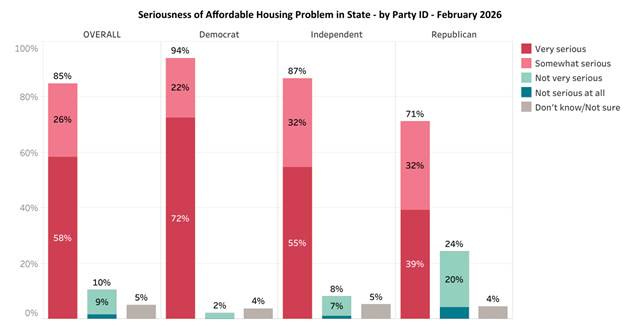
Lamont received criticism from his own party for vetoing a housing bill proposed by state democrats last year. He later signed another housing bill that state democrats have discussed in Stamford as a “roadmap” for housing. Lamont has since proposed a rent cap to prevent out-of-state landlords from increasing rents by more than a few percentage points per year. The poll found 68 percent of Connecticut residents generally support rent caps for landlords.
Local housing experts claim market rate units keep housing costs stable, but neither Lamont nor any other top challenger candidate has proposed policies for increasing housing supply of market rate units.
Elliott’s campaign focuses on expanding housing subsidies and rent stabilization.
Neither Fazio nor Stewart have any stated policies on housing development.
The gubernatorial primaries for both parties are scheduled for August 11, 2026, with the general election on November 3.
[1] The Nutmeg State Poll was conducted by the University of New Hampshire Survey Center between February 12 and February 16, 2026, among 583 Connecticut residents. The margin of sampling error is +/- 4.1%. The poll included 174 likely Democratic primary voters (MOE +/- 7.4%) and 99 likely Republican primary voters (MOE +/- 9.8%). Data were weighted by sex, age, education, region, party registration, and 2024 election results.
[2] Participants in the survey self-described as these labels (progressive, socialist, moderate, liberal).
[3] Fazio won in 2022 by .2 percentage points. In 2024 he won by 3.4 percentage points.
[4] The poll specifically asked about a “up to $400” rebate for residents