

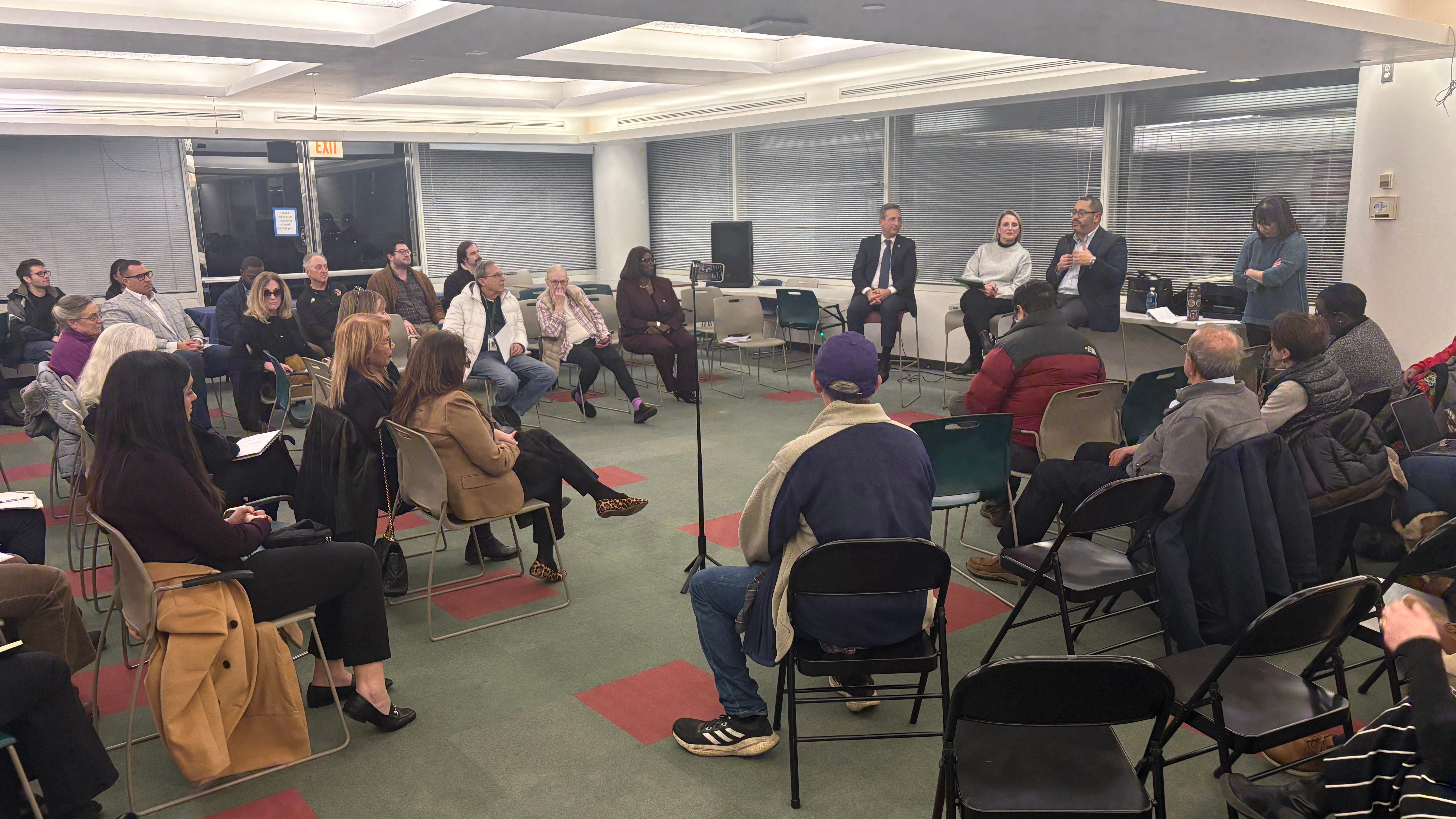
STAMFORD — High-ranking state Democrats detailed the friction stalling housing development in Connecticut at a housing town hall hosted at the Stamford Government Center on Tuesday night. State Senator Majority Leader Bob Duff and State House Majority Leader Jason Rojas were the primary participants for the event hosted by Indivisible Stamford.
The town hall focused on House Bill 8002 — the second housing bill proposed by Connecticut’s legislature after Governor Ned Lamont vetoed their first attempt — but shifted to a broader conversation about systemic hurdles stalling housing development in Stamford.
Stamford housing data
State Senator Patricia Billie Miller opened the forum by laying out housing data for Stamford.
“According to the Partnership for Strong Communities […] a person needs to earn $50.54 an hour to afford a home here. Keep in mind that the minimum wage just went up to $16.94 cents,” said Miller. “The data also indicates market rents [are] $2,200 for a studio and $4,400 for three bedrooms or more. [In] Stamford we have just over 55,000 units of housing, and out of that 7,900 are affordable.”
Miller framed HB 8002 as “just a roadmap” to provide regionally planning for housing in Connecticut.
Rojas said the most important component of HB 8002 is it strengthens municipalities’ ability to plan for housing.
“I think it creates stronger partnerships between the towns and the state but also allows our Councils of Governments to play a stronger role in trying to support our municipalities, many of which on the smaller side,” said Rojas. “I’m guessing Stamford has a robust planning department, but many of our communities around the state don’t. They simply don’t have the person power to engage in updating zoning regulations — not an easy thing to do.”
Councils of Government (COG) are regional organizations made up of elected officials from municipalities in their covered region. COGs provide technical expertise on a number of issues. Stamford is a member of the Western Council of Government — or “West COG.”
Duff said a key component of HB 8002 was its response to Lamont’s veto of HB 5002.
“The governor was very clear he wanted towns to take the lead,” said Duff. “So in our bill, […] that’s what we have as our state policy.”
HB 8002 provides incentives for towns to build housing rather than mandates.
“The proof will be in the pudding if communities do build housing like Stamford and Norwalk are,” said Duff.
“A thousand veto points”
Rojas referenced regulatory structures acted as an impediment to housing in Connecticut.
“We haven’t allowed enough housing to be built and that’s part of the challenge that we’re facing here. It all comes to a head where demand is far outstripping supply,” said Rojas. “I’m sounding like what a Republican should be talking about — reducing regulations, allowing the free market to respond to demand, but instead it’s Democrats taking up the mantle of trying to loosen up all those regulatory structures.”
Rojas’ comments suggest Connecticut Republicans no longer support free market policies — a claim backed by events in Stamford. In 2024, Republican Zoning Board Member Rosanne McManus received a vote of no confidence from Stamford’s Republican Town Committee for voting “in favor of zoning text changes contributing to over development.” McManus responded to the vote by changing her voter registration to unaffiliated.
Votes of no confidence are just one of what Rojas’ refers to as “veto points.”
“There are a thousand veto points to getting a unit of housing built,” Rojas said in a post-event interview with Feather Ruffler. “I know it’s not the sexiest solution to what is a very serious problem, but I think it’s actually being honest and real about how we address housing costs. It is reducing regulations, reducing burdens that are placed on people who build housing. The government [is] placing additional burdens on those owners of that property that inevitably pass along to the end user.”
When asked if housing economics follows supply and demand — the principle that providing more of a product innately reduces its price — Rojas said “Yes.”
“I do believe [supply and demand],” said Duff. “But we’re 100,000 units short of where we need to be so while we’re building housing, we’re not building it at a fast enough pace to necessarily have the biggest impact that we need to move prices.”
Growth Mandate
Duff and Rojas referenced the “pace” of housing development can cause problems for Connecticut communities. One problem is the divergence of incentives for renters and homeowners. The nonprofit organization Strong Towns argues America is in a “housing trap” where any policies addressing housing affordability also decreases the value of homes. For many American families, a home is their most valuable financial asset.
“We have to be careful with the political messaging around that,” said Rojas. “’Let’s build so much housing that the value of your home goes down.’ Not a winning message for the record.”
Strong Towns recommends “bottom up” housing reforms to address affordability without devaluing single-family homes. These reforms include deregulating zoning laws such as maximum units per lot, setbacks, and parking mandates. These policies have been implemented in states such as Montana — suggesting housing development has bipartisan support.
“[Housing] is more partisan in Connecticut, because if you look at red states they’re advancing a lot more aggressive housing reforms than blue states are,” said Rojas.
Duff suggested Connecticut’s housing policy has broader implications beyond more places to live.
“You got to grow or you die,” said Duff. “We can’t grow more jobs; we can’t grow our tax base if we don’t build more housing.”
What can ordinary people do?
Halfway through the event, the moderator posed the question: what can constituents do to support more housing?
“Have relationships with your legislators, talk to other legislators form other parts of the state, be a presence,” said Duff. “It’s really hard to get through big bills like this bill through the legislative process. You can only do it when you have the public behind you. […] When there’s a zoning proposal to build apartments or something else, the only people at those meetings are the people who say no. How about a couple people actually show up and say yes?”
“Forums like this are one of the important things you can do,” said Rojas. “Asking your legislator what’s actually in the bill as opposed to relying on an anonymous Facebook page is probably one of the best things you can do.”