

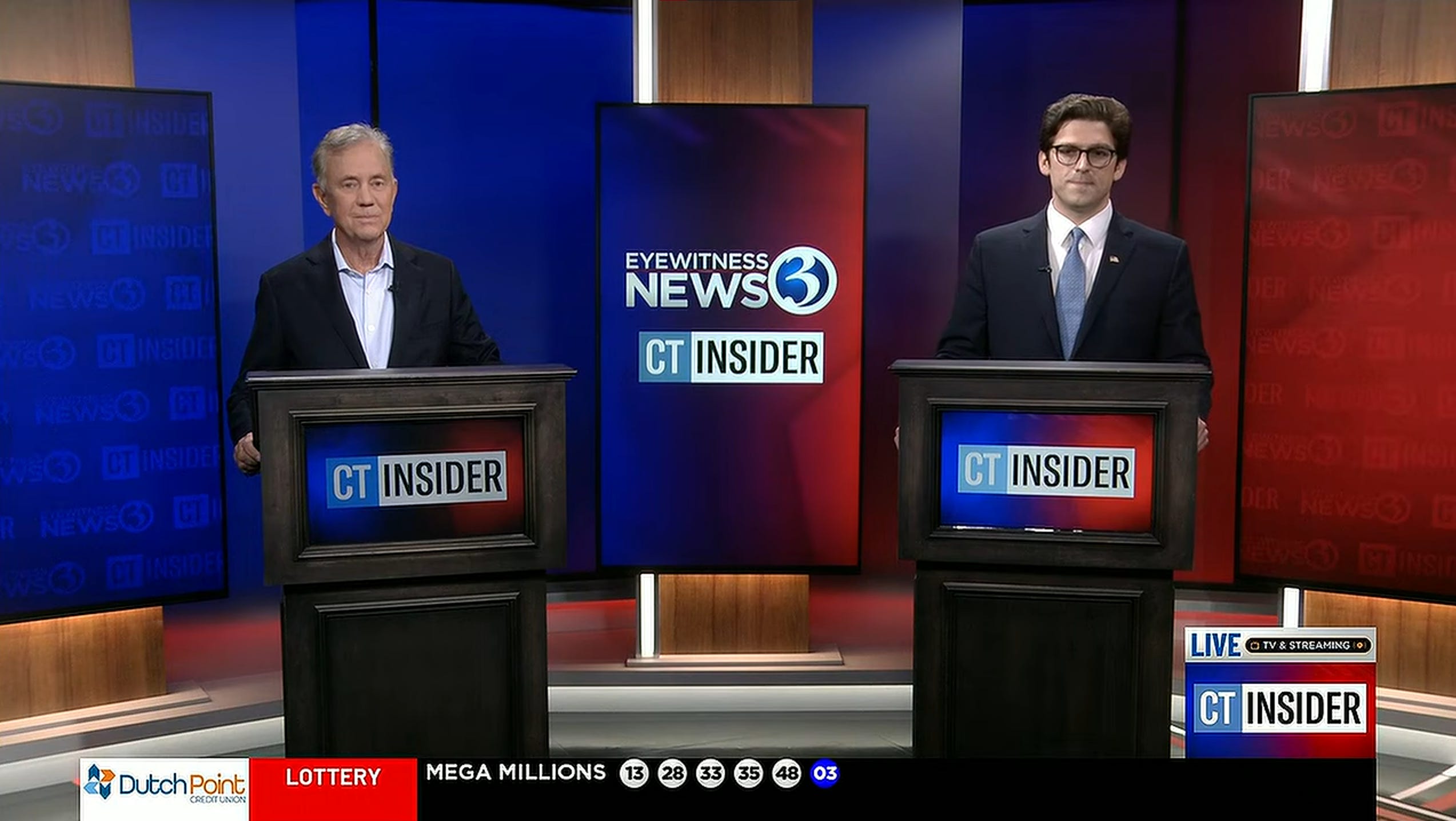
ROCKY HILL — Governor Ned Lamont and State Senator Ryan Fazio met Thursday night for the first debate of the general election for Connecticut governor, hosted by WFSB-TV and CT Insider at the WFSB studios in Rocky Hill. The hourlong debate covered taxes, electric bills, corruption, immigration, data centers, housing and health care.
WFSB anchor Erin Connolly moderated. WFSB chief political reporter Susan Raff and CT Insider columnist Dan Haar asked the questions — some of them submitted by viewers and readers. The full debate is available on YouTube. It was the first of two debates, according to CT Insider. Early voting is underway, and Election Day is Tuesday, Nov. 3.
Lamont, a Democrat, is seeking a third term. Fazio, a Republican, represents the 36th Senate District — Greenwich, parts of Stamford, and New Canaan. Here are five things that stood out:
The debate focused more on Lamont than Trump
Lamont brought up President Donald Trump or Washington in seven of his answers, including his opening and closing statements. He blamed Trump’s tariffs and the war in Iran for higher gas, heating oil, food and health insurance costs.
Responding to Fazio’s proposal for a gas tax holiday, Lamont argued state leaders cannot separate Connecticut from federal policy.
“By the way, you can’t mumble when it comes to Donald Trump,” said Lamont. “You seem to think that Washington is like Las Vegas. Everything that happens in Las Vegas stays in Las Vegas. Everything that happens in Washington impacts you every day.”
Fazio addressed that argument in his opening statement.
“Now tonight, you can expect Governor Lamont to blame those failures on Washington, D.C.,” said Fazio. “But leadership is about taking accountability. I’ve been willing to criticize the Trump administration when I disagree, just like Democrats in Hartford, and I’ll lead in the exact same way as an independent voice and a bipartisan leader.”
The moderators asked one question about Trump. Most of the remaining exchanges were about Lamont’s eight years in office — taxes, electric bills and corruption.
On taxes, Fazio said Lamont has raised taxes by $3 billion. Fazio said the figure adds the net of Lamont’s tax changes — “roughly 400 million dollars per year in tax increases” — across his eight years in office. Lamont said he signed the largest income tax cut in state history. The 2023 cut was worth about $460 million and affected roughly 60 percent of tax filers — according to the Lamont administration.
Fazio said Lamont raised taxes on food in the 2019 budget Lamont signed — which raised the sales tax on prepared meals from 6.35 percent to 7.35 percent.
On electricity, Fazio said Connecticut has the fourth highest electric bills in the country. That was true as of August 2025, according to U.S. Energy Information Administration data. Since then, residential rates have fallen about 10 percent and Connecticut now ranks 12th, according to CT Mirror. Lamont said Connecticut has the second lowest rates in New England, which is consistent with July 2026 federal data showing only Vermont lower.
Most of that decrease came from changes to the public benefits charge, the line item on electric bills that funds state energy programs and power contracts. A 2025 state law allowed up to $300 million in state borrowing to offset the charge. Fazio cited that borrowing when he said Lamont “shifted rates to taxpayers.”
Fazio also cited recent comments from Eversource CEO Joe Nolan. At a Sept. 30 investor presentation, Nolan said political criticism of the utility would quiet down after the election, according to audio released by the Fazio campaign.
“But all that noise in 37 days, you’re going to see the volume is going to go right down,” said Nolan. “You won’t hear much of that.”
Text messages from June 2025 published by CT Insider show Nolan asked Lamont “please don’t leave town until we have a deal on storms,” referring to a dispute over nearly $1 billion in storm costs. CT Mirror reported there was no indication Lamont acted on Nolan’s request. At the debate, Lamont said there was “just no truth to this at all” and said Eversource has sued the state repeatedly over regulatory decisions.
On corruption, Fazio criticized the Connecticut State Colleges and Universities (CSCU) system. A 2024 audit found former CSCU Chancellor Terrence Cheng spent about $27,000 on his state credit card, about $19,000 of it on meals. Lamont described the spending at the time as “small ball.” Cheng left the position in 2025 and continued to receive his $442,187 salary through June 2026 before moving into an advisory role. Fazio described it as a “no-show job.”
Lamont responded by comparing Cheng’s spending to Trump.
“Terrence Cheng spent too much on his credit card,” said Lamont. “Donald Trump has just received a $450 million [jet as a] gift from the Qataris. You got to keep some perspective here.”
Fazio also cited Kosta Diamantis, Lamont’s former deputy budget director, who was convicted on 21 counts of bribery, extortion and lying to prosecutors. Diamantis fled to Greece before he was sentenced to seven years in prison in September.
“Kosta Diamantis, I didn’t hire him, but I fired him,” said Lamont.
Fazio breaks with Trump on Iran and ICE
Fazio is considered a traditional Republican — as opposed to a “MAGA Republican” — by political analysts, but previous Democratic opponents have attempted to label him as “extreme” for supporting President Trump. According to CT Mirror, Fazio voted for Trump in all three of his presidential elections. On Thursday, Fazio named specific disagreements with the administration.
Raff asked Fazio if he supports Trump’s foreign policy, noting tariffs and the war in Iran have affected household costs.
“I oppose the war in Iran,” said Fazio. “I’ve said it repeatedly. I’m more of a non-interventionist. I actually respect [that] in 2006, when Ned Lamont ran for the Senate in opposition to the Iraq War. I think he was right at the time, and I’ve been critical of the decision to go into Iran.”
Fazio then said the election is about state policy and called for an immediate gas tax holiday of 25 cents per gallon. He said it would cost just over $100 million and could be paid for by a $600 million surplus in the Special Transportation Fund, which pays for roads and bridges. Lamont suspended the gas tax in 2022 and floated another holiday in March 2026. At the debate, Lamont said a holiday would “leave a hole in the budget.”
On immigration, Haar asked whether the candidates support U.S. Immigration and Customs Enforcement (ICE). Fazio said ICE should be stopped when it violates people’s rights, and also criticized Lamont’s immigration policies.
“We need a common sense policy to public safety and immigration,” said Fazio. “I think we all can agree, Democrats and Republicans, that we should take criminals off the street, people who are the most dangerous to society. But we also need to stop ICE or anyone else when they’re overreaching, when they’re violating people’s rights. I think that we can protect civil liberties at the same time that we protect public safety.”
Fazio cited the death of Liam Rivera, a 2-year-old Stamford boy whose body was found buried in Cummings Park in January 2023. Both of his parents pleaded guilty and were sentenced to prison, though which parent killed the child remains unknown, according to the Stamford Advocate. His father, Edgar Ismalej-Gomez, was previously convicted of a Class C felony after pleading guilty to breaking his then-6-month-old son’s arm. State probation officials lost track of Ismalej-Gomez before the killing. CT Insider described him as not a legal U.S. resident.
Connecticut’s Trust Act limits when state and local law enforcement can hold people for federal immigration authorities. For example, state law enforcement can notify federal immigration authorities about people convicted of class A or B felonies, but not class C felonies. Fazio argued that without the law, Ismalej-Gomez would have been transferred to federal authorities after his earlier conviction rather than released.
“That boy might still be alive today if not for that policy,” said Fazio.
Lamont said the case “has nothing to do with immigration” and said the state works with ICE, the Drug Enforcement Administration and the FBI to remove dangerous people. He pointed to recent immigration arrests in Danbury.
“The difference between you and me, Ryan, is every time you talk about an immigrant, you bring up a criminal alien and a crime,” said Lamont. “I think about the kids I used to teach at Harding High School. … I will do everything I can to keep this state safe, but hell if I’m going to victimize, you know, these poor kids who are just trying to get to school and get by. We used to call them the dreamers. I still call them the dreamers.”
Lamont also raised Fazio’s past comments on abortion. Fazio called Roe v. Wade “offensive to the rule of law and to millions of informed and motivated voters” in a 2018 article published in The Federalist.
“I don’t know if you can count on him in the final two years of a Trump term,” said Lamont.
Lamont’s criticism of Fazio’s comments conflates two different conservative movements.
Traditional conservatives view abortion as a moral issue and support “pro-life” policies outlawing access to abortion nationwide. This movement dominated Republican politics under the presidencies of Ronald Reagan, George H. W. Bush, and George W. Bush.
Judicial conservatives view Roe v. Wade as a judicial issue and oppose “living constitution” interpretations that enable the Supreme Court to “legislate from the bench.” In other words, “living constitution” interpretations give Supreme Court justices the ability to invent laws through “interpretation.” Critics of “living constitution” interpretations believe lawmaking should be a power held exclusively by congress — a bill legalizing or outlawing abortion should be passed by congress.
The overturning of Roe v. Wade as a result of the Dobbs case is seen as a victory for judicial conservatives concerned about overreach of the Supreme Court. Since Dobbs, the Republican Party Platform dropped its call for a national abortion ban.
Fazio’s comments that Roe v. Wade is “offensive to the rule of law” are consistent with a judicial conservative view that opposes the “living constitution” interpretation of that case while still supporting access to abortion.
“I’m proud of the law that I pass with bipartisan support to expand access to contraception for women,” said Fazio. “I support keeping abortion legal in the state of Connecticut.”
Sharp on policy, no personal insults
Neither candidate used nicknames or personal insults. That is a contrast to the Republican primary debate on WTIC 1080 in May, where former New York Lieutenant Governor Betsy McCaughey repeatedly called the governor “Lefty Lamont.”
The debate had pointed exchanges. Lamont called Fazio’s tax plan “fantasy land.” Fazio called Lamont’s response on the Stamford case “disingenuous.” Lamont called ICE’s treatment of immigrants “un-American.” Each of those exchanges was focused on policy positions.
The middle of the debate took a break from policy questions when the moderators held a lightning round on personal questions. Both candidates were asked questions on hidden gems in Connecticut, favorite TV shows, what book they’re reading now, and which three people (living or dead) would they invite to dinner.
Both candidates named Abraham Lincoln as a dinner party guest. Fazio added Jesus and Babe Ruth. Lamont added Zhou Enlai and Paul McCartney.
“We’ll have Abraham Lincoln over together,” said Lamont.
The issue nobody raised: age
Lamont was born Jan. 3, 1954, and is 72 years old. Fazio was born March 27, 1990, and is 36 — half Lamont’s age. If elected, Fazio would be the youngest sitting governor in the United States. Arkansas Governor Sarah Huckabee Sanders, 44, currently holds that distinction, according to a list of current governors by age. Lamont is the eighth oldest of the 50 governors.
Neither candidate made age an issue. Fazio came closest in his closing statement.
“The first time he ran for office was the year I was born, for the office that I currently hold,” said Fazio. “He’s been in politics for decades, and after eight years, Connecticut is more expensive than it’s ever been.”
Lamont did not reference Fazio’s age at any point in the debate.
Where they agree: data centers, surveillance cameras and the stated goal of more housing
Both candidates said they oppose large AI data centers in Connecticut. A Sacred Heart University poll conducted with WFSB and CT Insider found voters across parties oppose data centers, Haar said in his question.
“Look, we have not allowed any of those big AI data centers into this state, and I don’t think we are going to,” said Lamont. “They are big energy sucks. The one they wanted to bring in next to Millstone, which is the nuclear power plant, would have used more electricity than all of Southeast Connecticut combined.”
Their disagreement is over a 2021 law Lamont signed that offers sales and property tax exemptions for data centers. One company has used it: Cigna saved an estimated $17 million in sales taxes on improvements to its data center in Windsor. Fazio has called for ending the tax break.
On automated license plate readers like Flock cameras, Fazio said he was the first candidate for governor to speak out against them. Lamont asked towns to pause new installations in August while the state reviews the technology. Lamont said his administration’s proposal would bar towns from sharing the data with ICE or other federal law enforcement, and require it to be deleted after a period such as 21 days. Lamont said Fazio opposed that proposal and an AI bill meant to protect children. Fazio said he co-authored a law limiting social media in schools.
On housing, both candidates said they want more homes built. Fazio said the first step is lowering property taxes through a cap, and said he supports accessory dwelling units, mixed-use zoning and lower licensing fees for the trades.
“But we also should protect local control,” said Fazio. “We shouldn’t permit the big out-of-state developers to do whatever they want without local input. Governor Lamont signed a law that allows more of that. I oppose that.”
Lamont cited the state’s housing law and its “towns take the lead” approach, which lets towns set their own housing plans. He said the bill had support from Republican and Democratic mayors and first selectmen but no Republican legislators.
Lamont vetoed a broader housing bill in June 2025 after local leaders opposed it. He then signed a revised bill passed in a November 2025 special session. The revised bill requires towns to create housing growth plans and removes parking requirements for apartment buildings with fewer than 16 units.
A note from Arthur
Feather Ruffler’s policy is “not partisan, but non-neutral.” It is not “bias” to have an opinion — especially when it comes to differing visions on the future of Connecticut. My personal viewpoint is Lamont has been a fine governor and Fazio would probably be good too.
Fazio won this debate. He won because the conversation was about all the things he wants to talk about — Connecticut and Lamont’s record.
It is truly incredible Lamont’s pursuit of a third term isn’t immediately dead in the water. Not because he’s done a bad job, but because incumbents are having a hard time right now.
Political incumbents are having a hard time because of the lingering economic impact of the COVID pandemic. A global health emergency that shuts down large swaths of the economy necessarily required huge government stimulus spending that resulted in inflation.1 Inflation is incredibly unpopular and affects every aspect of the economy, which is why you’ve seen incumbent politicians have a difficult time holding onto their seat. The most extreme example of this is the United Kingdom where they have cycled through seven Prime Ministers in ten years — mostly because of economic problems with no good answers. The economy hurt both Trump and Biden in their respective re-elections (or Harris, by extension) because incumbents are in general not popular. People want something different.
Fazio succeeded in focusing the debate on all those problems. He did so in a style that is refreshing for a Republican candidate. He came with specific examples, numbers, and policy alternatives. He didn’t misrepresent Lamont, call him names, or fake outrage over their disagreements. It was a civil disagreement on policy and priorities.
One thing Republicans undervalue about Lamont’s popularity is he is not very partisan. Most voters have a positive view of Lamont even if they wish he accomplished more. Fazio is striking that tone of critique without being too negative on Lamont at a personal level. This is different from the national Republican party.
I view Fazio as representing a new era of politics where adults are back in the room. If there were ever a time to “pass the torch,” it would be now. Republicans will likely get trounced nationwide and Fazio shows how to achieve conservative goals that affect everyday people without the toxicity of the past 10-20 years.
Unfortunately for all of us, that toxicity is still the dominant factor of politics today. Fazio can have a better plan for any issue, but it will always return to: “yeah, ok… but what about Trump?”
Voters — especially Connecticut voters — are tired of living in “interesting times.” They want some stability. Trump has characteristically caused maximum chaos through tariffs, the war in Iran, and subsequent inflation. Even if Trump’s national agenda will almost certainly be curtailed by nationwide losses in Congress and the Senate — voters likely don’t have the nuance to support a local governor while opposing a national agenda.
Fazio made some attempts to create a distinction between him and Trump. He said he opposed the war in Iran, suggested ICE is violating civil liberties, and restated his — often maligned — support for access to abortion and birth control in Connecticut. This is probably enough to upset the MAGA loyalists while achieving little for the moderates who have a deep distrust of Trump and his priorities. But for what it’s worth, I found it meaningful.
I was planning to not vote at all this November. I have some personal disagreements with Fazio’s policy platform. He appears to have calculated Boomers vote more than Millennials so he’s supporting Boomerism policies I think are awful — such as capping property taxes. I’m also an “AI Guy” and I have a strong distaste for everyone wrapped up in anti-data center hysteria.2 Of course, both Lamont and Fazio are playing these games. On top of my disappointment locally — the national situation is a disaster. I have an article in my drafts called “Everything I Hate About the Republican Party” which I may or may not ever publish. All of this feeds into a supreme indifference over politics right now.
But the debate was a reminder this era of politics could end in this very election. It probably won’t, but I think that’s worth voting for.
Personally, I think the “soft landing” of the economy achieved under Powell/Biden was basically a miracle tantamount to an act of God.
You should read this whole article, but one highlight for me is the support for building a “data center for AI” polls at -35 but a “data center for streaming video” — which is the same exact thing — polls at -18. Meanwhile, truly ecologically damaging usages like a truck depot or steel plant poll at +44/43.