

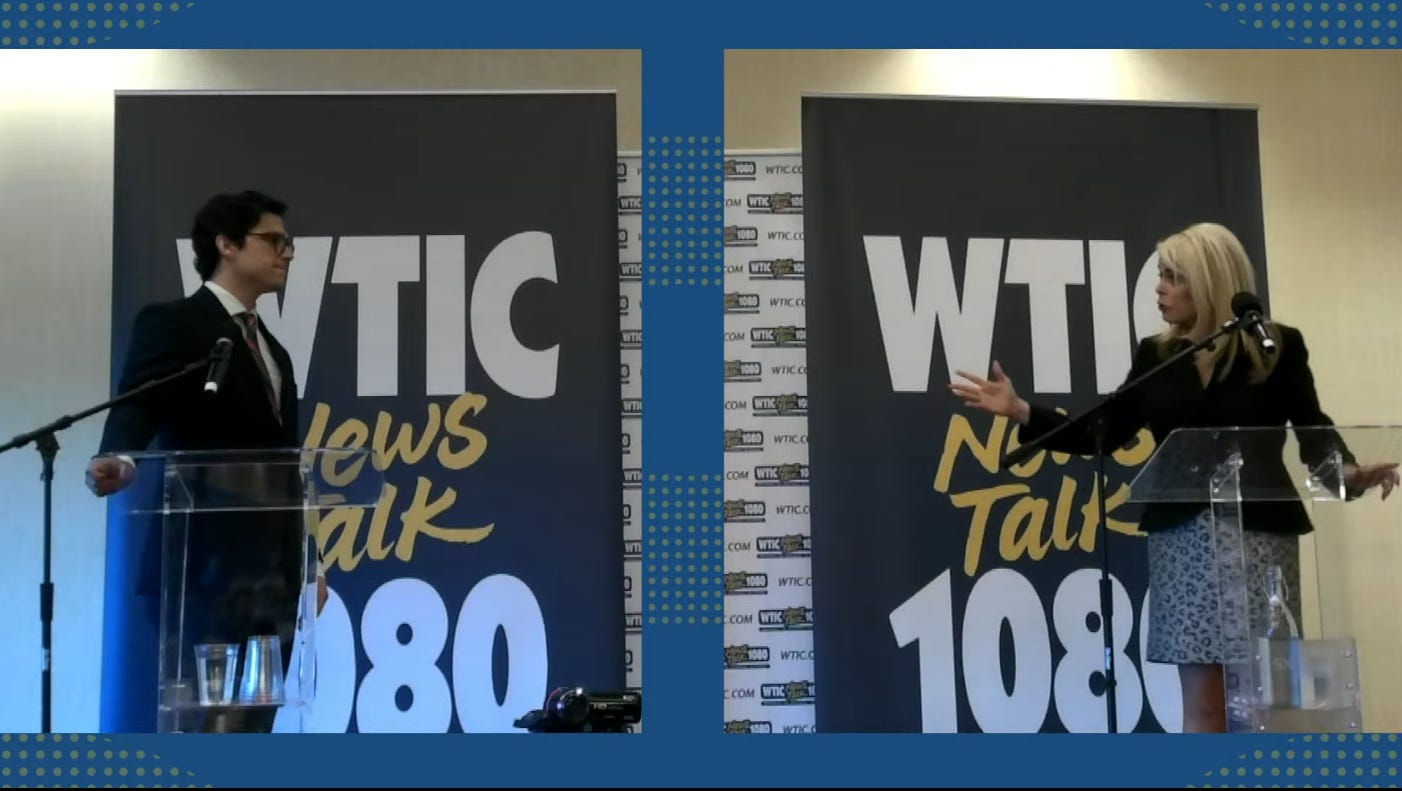
HARTFORD — State Sen. Ryan Fazio and former New York Lt. Gov. Betsy McCaughey met Wednesday night in a Republican gubernatorial debate hosted by WTIC News Talk 1080 in Hartford. The debate — moderated by Reese on the Radio, Brian Shactman, and Morgan Cunningham — covered taxation, energy, pension debt, and unifying the Connecticut Republican party.
The full debate is available for free on YouTube and covered familiar topics for Connecticut Republicans: taxes, energy costs, and criticism of Lamont. The debate revealed key differences between the style and substance of each candidate’s campaigns. Here are five that stuck out:
1) “Red meat Republican” vs. “disagree without being disagreeable”
The clearest difference between Fazio and McCaughey was their choice of words.
McCaughey deployed Trumpian branding throughout the debate. She called incumbent Connecticut Governor Ned Lamont “Lefty Lamont” multiple times and later “Windbag Lamont.” She said Connecticut’s Attorney General William Tong has “succumbed to Lefty Lamont ideology” and is driven by “Trump derangement syndrome.” She directed similar insults to New York Governor Kathy Hochul who she called “Crazy Kathy Hochul” and New York City Mayor Zohran Mamdani an “invader” who is turning the city into “a socialist hellhole.” McCaughey’s bombastic branding was applied to her own initiatives as well. She referred to herself as a “red meat Republican” multiple times and pitched her campaign as the “Connecticut comeback.” McCaughey criticized Fazio’s policies at times, but did not use any nicknames for her opponent.
Fazio did not use nicknames or branded statements for any person or group — Democrat or Republican.
The contrast extended beyond rhetoric. When responding to a question about Lamont’s energy policy weaknesses, Fazio complimented the governor and said “God bless him, I really like the guy.”1 When McCaughey directly responded to Fazio’s answer on energy with “I can cut the rates more and I have a bolder plan,” Fazio began his response with “She’s totally right.”
Later in the debate, an audience member asked how the candidates would bring civility back to government.
“I believe, and firmly believe, that you can be disagreeing without being disagreeable and I think I’ve done it my entire career,” Fazio said. “I think you should always criticize the action before you criticize the individual, and even if you have to criticize the individual, do so before you criticize an entire group of people for their character. We should focus on the issues and the policies.”
“He’s a very civil person. I congratulate him on that,” McCaughey said in reference to Fazio while responding to the same question. “I am a red meat Republican, and I love to talk to the other side. I’m very cordial with the other side, but I don’t want to compromise on things like eliminating the income tax or eliminating mandates for renewable energy that are forcing up the price of what we pay on our electric bill.”
National voters have been polled on if they prefer a candidate who will “stand up” or “compromise” with the other side. These poll questions do not frequently use the same language and different polls have found significant differences across demographics and election years.
2) McCaughey repeatedly referenced her proposal to eliminate state income tax
The first question of the evening was directed to McCaughey about her policy to eliminate the state income tax. She said Connecticut should follow the 18 states reducing their income taxes toward zero and claimed the President’s Council of Economic Advisers reported her state income tax proposal would result in a 25 percent increase in business startups and $6,700 more in pre-tax earnings for the average worker. McCaughey estimated it would take “five to seven years” to reduce the state income tax to zero.
Fazio responded with his own proposal to cut spending by $1 billion and provide an average of $1,500 in tax relief to families in Connecticut. McCaughey called Fazio’s proposal “baby steps.”
“Voters can tell whether the plans that we offer are credible and realistic,” said Fazio. “I will offer the most ambitious and realistic plans possible on this campaign.”
McCaughey brought up her state income tax proposal again across six different questions.
On fiscal guardrails? McCaughey argued for a hard spending cap so that “all new revenue goes to reduce taxes, and then we will make Connecticut a zero income tax state.”
On party unity? McCaughey said she would motivate the party with unapologetic Republican goals. “For example, on the issue of the income tax. Let’s not negotiate with ourselves. Let’s go for a big, bold goal and try to meet it,” she said.
On civility? McCaughey said she was “cordial” with “the other side” but “I don’t want to compromise on things like eliminating the income tax.”
On her day one agenda? “I am going to start ramming through that bipartisan legislation to eliminate — read my lips — the income tax,” said McCaughey.
On marketing Connecticut? “We can do it by eliminating the income tax,” said McCaughey.
In closing? McCaughey said she would bring “bold solutions like eliminating the income tax — not baby steps.”
Generational divide on debt
Connecticut has spent billions over the past seven years paying down long-term pension debt — a bipartisan effort enabled by the fiscal guardrails enacted in 2017 when the state Senate was tied between Republicans and Democrats. McCaughey wants to slow that down. Fazio does not.
Feather Ruffler has written how public debt is a generational issue. The American political system is designed around what is now referred to as “Total Boomer Luxury Communism,” where political and fiscal priorities are focused on providing luxury benefits to people over the age of 65. Uniquely, these benefits are not paid for by collected taxes but instead funded through debt — debt that will become more expensive to pay off when Boomers reach their end of life within the next 10-20 years.
Ryan Fazio was born in 1990 and will be 36 on election day. He is part of the Millennial generation which will take on debt payments for benefits paid for “Boomerism” policies. Fazio said he supports paying down debt.
Betsy McCaughey was born in 1948 and will be 78 on election day. She is part of the Boomer generation which has benefited from “Boomerism” policies for decades. McCaughey said she would “slow down” debt payments.
“Most people in this room and in this state do not lie awake at night worrying about the state debt, but they sure lie awake at night worrying about their own debt,” McCaughey said. “And when we’re taking their hard-earned money to pay down that state debt when they can’t afford their own debts, that is wrong.”
When moderator Brian Shactman pressed her on whether she would stop paying down pension liabilities entirely, McCaughey said: “I would definitely slow down what’s been done.”
Fazio argued the math makes slowing down counterproductive.
“The problem with those long-term debts, especially the pension liabilities, is they get bigger and bigger at 8 percent every year,” said Fazio. “So if you’re not meeting them every single year, then they’re going to double in just a few years’ time.”
Fazio framed Lamont’s reputation on fiscal issues as misleading.
“He was elected on a false pretense to be fiscally responsible as a Democrat and to defend taxpayers, but he has eviscerated the very fiscal budgetary guardrails that he inherited in his first term by the end of his second resulting in billions in dollars, in more debt, [and] much higher taxes,” said Fazio.
A narrow distinction on housing
Republicans in Connecticut respond to most questions about “housing” with concerns about “local control.” Both McCaughey and Fazio said they opposed state-directed housing efforts such as the housing bill 8002 Lamont signed in December 2025 and 8-30g — which allows for the bypassing of local zoning regulations if a municipality has less than 10 percent housing stock defined as “affordable.” While supporters of 8002 and 8-30g focus on the intent (provide more affordable housing), critics focus on the state overreaching on a municipality’s ability to decide its own housing strategy (e.g. “local control”).
McCaughey’s housing answer focused on housing bill 8002, claiming it was not about affordable housing but economic diversity.
“That is not the government’s job to impose a cookie cutter template on every town in the state requiring the same sociodemographic population,” said McCaughey. She added the focus should be on making new housing easier to build, more affordable to build, and providing vouchers to people who cannot afford housing.
Fazio agreed with McCaughey’s answer, but structured his priorities around reducing property taxes, reducing costs for maintenance on existing housing infrastructure, and finally local control” for municipalities.
“Focus on smaller scale development that towns and cities and neighborhoods will embrace rather than reject, like the accessory dwelling units, like the mixed use — the small apartments above the shops in a downtown,” said Fazio. “Make it easier for workers in the trades to get licensed, cut their licensing fees to zero. They shouldn’t have to pay the government just for the right to work every single year.”
Fazio’s answer creates a narrow distinction in his view compared to other "local control” advocates.
In Stamford, politicians of both parties oppose accessory dwelling units, mixed use, and deregulation for housing construction. Pro-housing advocates associate these views with the goal of “local control” — since many advocates for “local control” use it to restrict housing markets. Fazio’s answer suggests local control could be used for pro-housing policies. It is a narrow distinction, but it exists.
The missing candidate
The one other Republican candidate running for governor – Erin Stewart – declined to attend the event.
Fazio and McCaughey both referenced Stewart’s absence without naming her directly.
Fazio’s references were structural. In his opening answer on taxation, he said questions asked in debates “are important for our candidates for governor to answer in an extemporaneous way, with no notes.” Later he said the question about how the candidates would work with a Democratic legislature “should be answered by all candidates.”
McCaughey was more direct. In her closing statement, she criticized her opponents.
“We need to win this election with bold solutions like eliminating the income tax — not baby steps, like reducing taxes $1,500, or what another candidate says, a vague promise for ‘something different.’”
“Something different” is Stewart’s campaign slogan. Stewart launched her gubernatorial campaign in November 2025 with the tagline “It’s time for something different,” positioning herself as a generational change candidate with executive experience from her 12 years as mayor of New Britain.
Stewart did not attend or comment on the debate.
A note from Arthur
Feather Ruffler’s policy is “not partisan, but non-neutral.” I don’t think “having an opinion” should be considered “bias.” It’s not bias to recognize some ideas are better or worse than others. Additionally, it is difficult to control for things like asymmetrical coverage or incomplete reporting without a team of people aware of these concerns.
With that in mind, I think Fazio performed better at the debate and this article may reflect that view.
McCaughey appeared to succeed in getting across the branding she wanted for her campaign. She has a fiery speaking style and is actively seeking endorsements from national Republicans. She wants to focus on homeowners and reverse the state income tax which was introduced in her lifetime.2 That may be her brand — I just personally hate it.
A 78-year-old woman using cringe poems and stupid nicknames to court an endorsement from Donald Trump in pursuit of policy pipe dreams is everything I do not want in an elected official. Everything you can Google about how she stopped being Lieutenant Governor of New York I also find totally disqualifying.
Fazio is a strong contrast. He talked about a number of policies in detail. He didn’t insult his Republican opponents — or any Democrats. He took several opportunities to agree with McCaughey during the debate and even said something nice about the incumbent Governor while laying out his policy disagreements.
I would have liked to see Stewart attend the debate to articulate her priorities and defend herself from common criticisms, but she didn’t.
Between three candidates where one seems normal, another is everything I hate about national politics, and a third one doesn’t even show up — it’s hard to come to any other view than a preference for Fazio’s candidacy.
Longer quote for context: “This is why it’s so important for us to nominate a candidate who knows these issues and knows these issues better than the governor knows these issues. Do you think he really wants to stand on a debate stage? God bless him — I really like the guy — but do you think he really wants to stand on a debate stage with me who knows these issues granularly and can explain precisely how they are misleading the public?”
Although, not in my lifetime.