

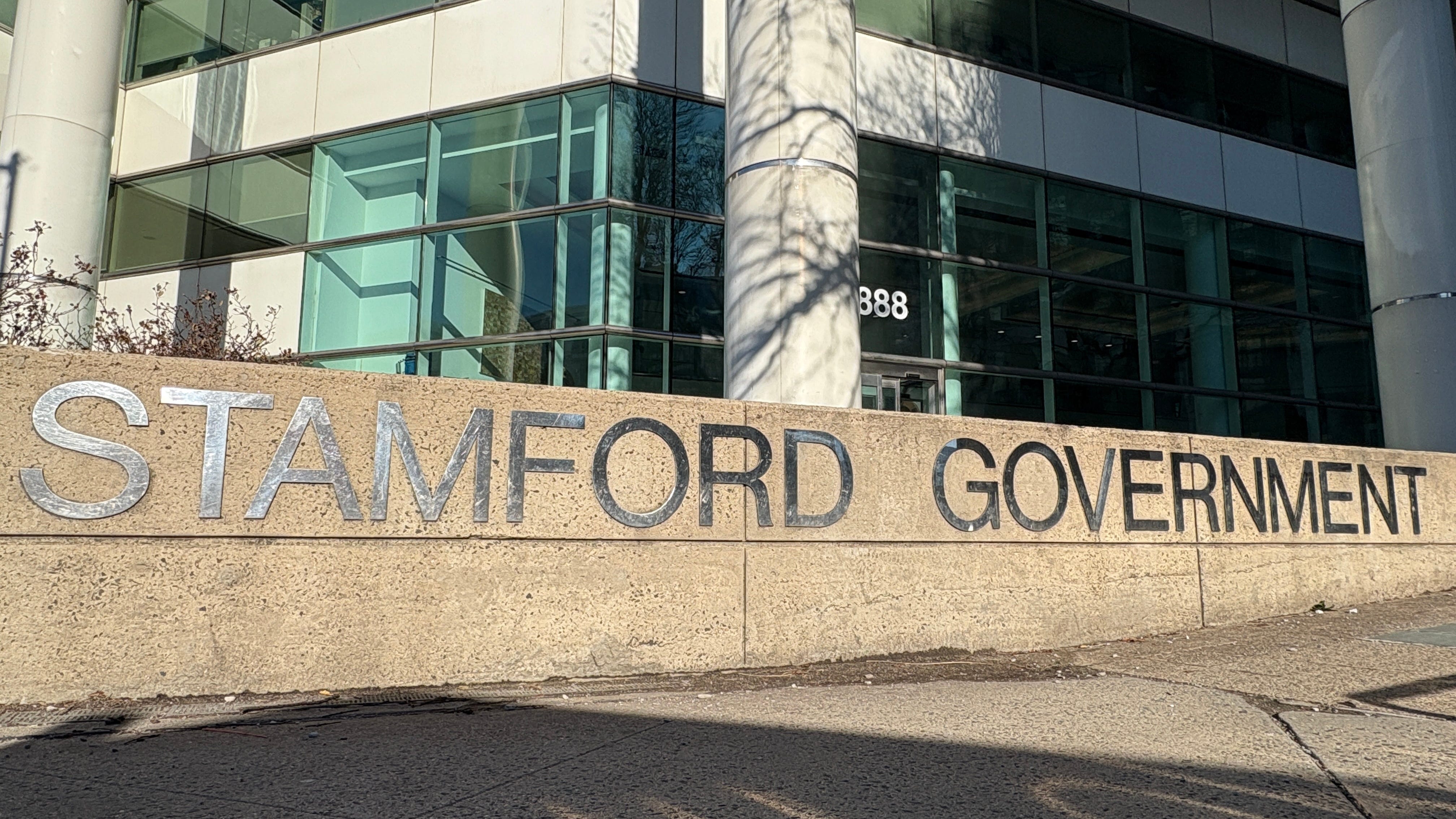
STAMFORD — The Board of Representatives voted to authorize a project labor agreement for the construction of the new Roxbury School at its regular meeting at the Government Center on Monday, May 4, capping nearly 90 minutes of debate that Majority Leader Eric Morson called the best he’d seen in nine years on the board.
The vote was the centerpiece of a meeting that also saw the board name the Stamford High School sports fields despite objections about diversity, dissolve the Stamford Transit District, and approve $6.3 million of general fund surplus.
Roxbury School labor agreement authorization passes 28-11
The resolution (CHESS32.005, discussion begins at 1:03:48) passed 28-11-0, according to the meeting’s action report, the board’s official minutes document.
A project labor agreement (or “PLA”) is a pre-hire contract negotiated with labor unions that sets the working terms — wages, dispute resolution, hiring rules — for every contractor on a specific construction project, whether that contractor is unionized or not. PLAs are common on large public projects in Connecticut cities including New Haven, Bridgeport, Hartford and Waterbury, but Stamford has not used one on its recent school projects, including West Hill High School — the largest school construction project in the state.
The board did not approve a PLA itself. No agreement exists yet. The resolution, submitted by Director of Operations Matt Quiñones, authorizes O&G Industries — the project’s construction manager — to negotiate a PLA with the Connecticut State Building Trades Council on the city’s behalf. The board will receive the finished agreement for information purposes only. (First-time readers can learn more about the Department of Operations here.)
That distinction — voting to authorize a contract nobody has read — did more to drive opposition than any argument about unions. Board Clerk Parker Johnson — who votes as a representative — said conversations with city staff earlier that day had changed his reasoning but not his position.
“What we are approving tonight is not a PLA. It’s an approval for a third-party company, O&G, to negotiate a PLA on our behalf,” said Johnson. “We have absolutely no mechanism for enforcement outside of hoping O&G keeps our preferences in mind.”
Representative Felix Gardner made the same argument in response to Representative Nicole Beckham, who said she came in “a hard no” and would vote yes if the resolution’s workforce promises could be guaranteed.
“There is no guarantee at all,” said Gardner. “It’s all based around a principle of good faith. It’s not actually contractually obligated by the contractor to be delivered, and they could not deliver it, and the city has no recourse whatsoever.”
Supporters framed the vote as a test of the board’s commitments. Representative Karen Camporeale, who opened the debate, closed her second round of remarks with the night’s most pointed question.
“If we, in a blue city with a Democratic mayor and a 40-body Democratic board of reps, don’t vote for unions now, then when do we vote for them?” said Camporeale. “Unions are declining in this country, and along with those unions declining, so is the middle class.”
Representative Steven Shore, a union member who spent his career bidding on projects, argued a PLA buys labor stability in a strained Fairfield County construction market — school construction delays displace students, not just budgets. He also read the resolution’s workforce commitments into the record: the trades council will make good-faith efforts to hire Stamford residents, and the city will hire a third party to recruit at least 100 Stamford program participants into apprenticeship-readiness programs, prioritizing disadvantaged youth, with hiring goals of 60 percent minorities, 40 percent women and 10 percent veterans, plus an annual career fair beginning in fall 2026.
That pre-apprenticeship program converted several votes. Representative Candace Weathers said it was her reason for voting yes.
“Sometimes people sell you one thing, and then in reality something different takes place,” said Weathers. “I will be driving by some of these construction sites and taking pictures… Don’t sell me one thing and I vote yes, and then you implement a whole nother thing.”
Weathers said she specifically wants to see African American youth in the program, “transitioning over to union jobs, getting wages, getting pensions, and benefits.”
Representative Carl Weinberg offered to join Weathers and Beckham “in holding the administration accountable for their promises concerning the pre-apprenticeship program.”
Joe Toner, executive director of the Connecticut State Building Trades Council, previewed the union’s offer during public comment: one out of every five construction workers on the project would be a Stamford resident, with recruitment run through the Building Trades Training Institute.
Local evidence and national research
Gardner said the PLA “narrows the playing field before the game has even started,” comparing the result to airline prices after Spirit Airlines’ collapse.
Representative Lewis Finkel provided bid data: on Torrington High School, a PLA project, only eight of 26 bid packages drew more than three bidders. On Stamford’s own Strawberry Hill project, he said, two bidders came forward while a PLA was attached and six after it was dropped, with the eventual winner falling from $65 million to just over $45 million.
Representative Theo Gross countered that state law makes the competition argument moot, quoting a legal opinion from Quiñones’ office: “Connecticut statute explicitly prohibits discrimination between bidders based on labor organization affiliation.” The city must take the lowest responsible qualified bidder, union or not, and a winning non-union contractor can perform 100 percent of the work with its own employees.
Camporeale cited a 2024 UC Berkeley Labor Center study of Los Angeles affordable housing projects that found no statistically significant relationship between PLAs and total development costs.
Finkel cited a New Jersey Department of Labor report that found PLA school projects cost roughly 30 percent more per square foot. A Connecticut Office of Legislative Research review circulated to the board by Quiñones reached no definitive conclusion either way.
However, Berkeley’s Labor Center explicitly aligns itself with union interests. New Jersey’s Department of Labor has its own incentives against PLA contracts.
Representative Virgil de la Cruz, who voted yes, described a safety valve that eased his cost concerns: if bids for any package come in badly under the PLA, that package can be rebid without it.
On the final vote, Representatives Beckham, Finkel, Gardner, Amiel Goldberg, Johnson, Noah Lapine, John Pelliccia, Daniel Sandford, Scott Stone, Stephanie Sylvestre and Board President Ramya Shaw voted against, according to the action report.
Stamford High field namings pass 37-3 over diversity objections
The board voted to name the Stamford High School baseball, softball and soccer fields — a two-step process that drew the night’s only other extended debate (OPR32.009, discussion begins at 42:54).
City ordinance requires field honorees to have been deceased for at least six months. The board first voted to waive that requirement — which needed 30 votes — and passed 38-2-0.
The naming resolution (OPR32.010) then passed 37-3-0. According to the action report, Representatives Kindrea Walston and Anabel Hyatt voted against both, and Representative Chanta Graham voted against the naming.
Walston, who pulled the item off the consent agenda, read a letter into the record asking the board to consider the Cobb family — particularly Jimmy Cobb, a three-sport captain at Stamford High in 1970 who was named All-State in football and later spent roughly 15 years coaching in Stamford schools. Cobb was inducted into Stamford High’s inaugural hall of fame class but has no field, and Walston noted none of the honorees look like her.
“He was honored in 2007, he’s being honored in a few months, but where’s his name?” said Walston. “Put his name outside, so when little children [ask], who is that? That’s Jimmy Cobb.”
Walston proposed a statue of Cobb outside the baseball field as an alternative, an idea de la Cruz called intriguing, comparing it to the Joe Louis statue on Stillwater Avenue. Representative Bobby Pavia defended the honorees’ qualifications, and Weathers asked future naming committees to “be more equitable and have a little bit more inclusion” in assembling their lists.
Walston also questioned how many more times the board will waive the six-month rule — the 31st board waived it twice — and whether the ordinance needs rewriting.
Other business
The board gave final adoption to an ordinance dissolving the Stamford Transit District (T32.003, discussion begins at 2:20:37). The ordinance — submitted by Quiñones — passed unanimously by voice vote without debate after a public hearing held by the Transportation Committee on April 20.
On the fiscal consent agenda (F32.070, report begins at 33:31), the board approved a $6.3 million appropriation of fiscal year 2024 general fund surplus and $175,000 in community development funds to help the Boys & Girls Club complete the playscape at the Yerwood Center (F32.065) — a project Waterside resident Kieran Edmondson urged the board to support during public comment. A $2 million appropriation for renovations at the Family Centers site at 986 Bedford Street was recommitted to the Steering Committee after the Board of Finance held the item.
In the Board of Education liaison report, Representative Noah Lapine noted the Board of Education unanimously appointed Dr. Adrian Talley as the new superintendent of Stamford Public Schools on April 28. Talley begins July 1, succeeding Dr. Tamu Lucero. Lapine also reported the Board of Finance’s $12.1 million cut to the schools’ operating budget stands, with final state education funding figures still pending.
Two ordinances were postponed in committee: a repeal of the Appointments Commission and a measure requiring the Mayor’s office to report information about board and commission applicants. Both return next month.
After the votes, Morson asked for a moment of personal privilege.
“This is my ninth year on this board, and I have to say that I am honored, thrilled, so impressed with how this board just handled such a controversial issue,” said Morson. “An issue with multiple points of view, clear sides, the homework, the preparation, the respectful debate.”